Korean food doesn’t just taste good — it tastes layered in a way that takes a second to fully land. The sourness hits first, then the heat, then something deeper and savory that lingers after the bite is gone. That last part isn’t accident or seasoning — it’s the byproduct of microbial activity, measured in days or months, quietly building flavor compounds that no amount of fresh spice can replicate.
The answer to why Korean food tastes the way it does runs through fermentation science, capsaicin chemistry, and one of the oldest systematized preservation cultures in East Asia. And most of it happens before the cooking even starts.
The Science in 60 Seconds
- Fermentation is the engine. Lactic acid bacteria convert sugars into acids, alcohols, and esters — creating flavor compounds that don’t exist in the raw ingredients.
- Glutamic acid, the umami compound, accumulates during fermentation in kimchi, doenjang, and gochujang — building a savory depth that runs through almost every Korean dish.
- Gochugaru (Korean red pepper flakes) is not just heat. Its capsaicin ranges from 1,500 to 10,000 Scoville units, far milder than Italian chili flakes, and it contributes smokiness, fruitiness, and color alongside warmth.
- Jeotgal — fermented salted seafood — acts as a fermentation accelerant in kimchi, adding free amino acids including glutamic acid that turbocharge both flavor and microbial activity.
- The combination of multiple fermented ingredients in a single dish is the real multiplier. Kimchi on top of doenjang jjigae, ssamjang on barbecued pork — stacking fermented layers is how Korean cuisine builds intensity without heaviness.
Why Korea’s Geography and Climate Made Fermentation Inevitable
Korea’s fermentation culture wasn’t a culinary preference. It was a survival strategy shaped directly by the peninsula’s climate.
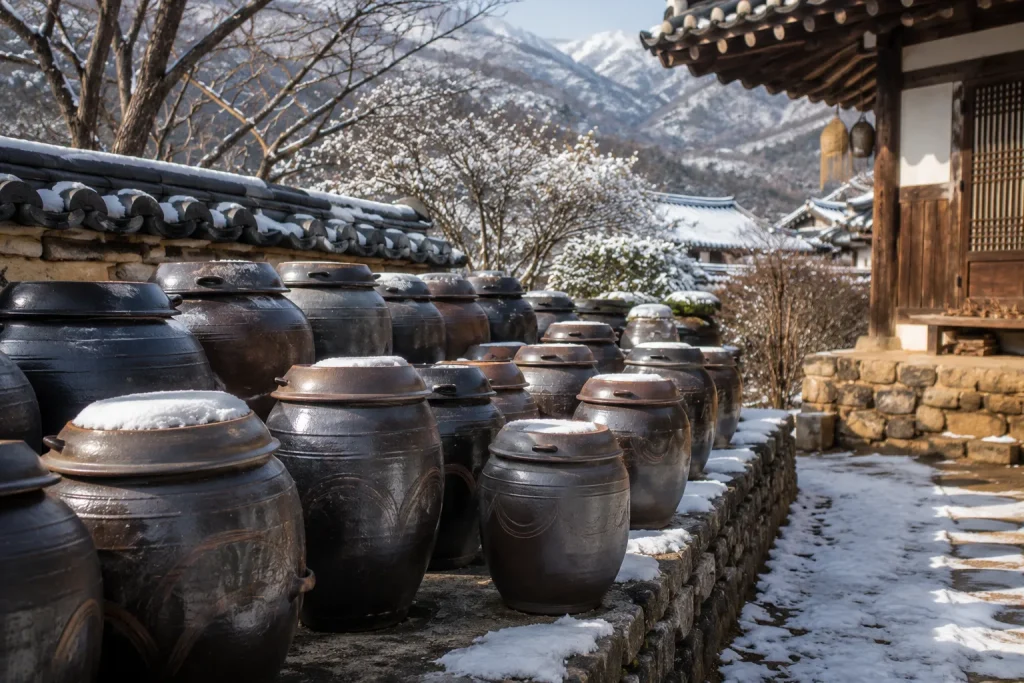
Korea has harsh winters — cold enough that fresh vegetables were unavailable for months at a time. Salting and fermenting cabbage, radishes, and other vegetables was one of the only viable ways to maintain a nutritious, caloric food supply through winter. This is the pressure that produced kimchi, and it explains why kimchi-making was not a recipe but a seasonal institution — every household’s annual napa cabbage harvest (baechu) went into large ceramic pots called onggi for fermentation.
The peninsula’s extensive coastline and fishing culture added the other critical piece. Kimchi is noted as potentially the only fermented food in the world that uses fermented fish sauce, derived from animal raw materials, to ferment a vegetable-based food. That’s jeotgal — salted fermented seafood — which turns up in traditional kimchi as anchovy paste, salted shrimp, or similar preparations. It’s not seasoning. It’s infrastructure.
The soybean, meanwhile, grows well across the Korean peninsula, and the first official record of doenjang appears in the Samguk sagi, historical records documenting that doenjang and other fermented pastes were served at the wedding ceremony of King Sinmun of Silla in 683 CE. Korean fermentation is not a modern food trend. It’s been a cornerstone of the diet for over 1,300 years of documented history.
One thing most flavor histories of Korea skip: chili peppers are actually newcomers. Chili peppers arrived on the Korean peninsula in the late 16th century — likely through trade contact with Japan following the Imjin War. Before that, Korean food was fermented, pungent, and savory, but not spicy in the way we recognize it today. The heat layer is recent. The fermentation layer is ancient.
What Fermentation Is Actually Doing on Your Tongue
Fermentation in Korean cuisine is not preservation with a flavor bonus. It’s flavor manufacture. The chemistry is specific and worth knowing.
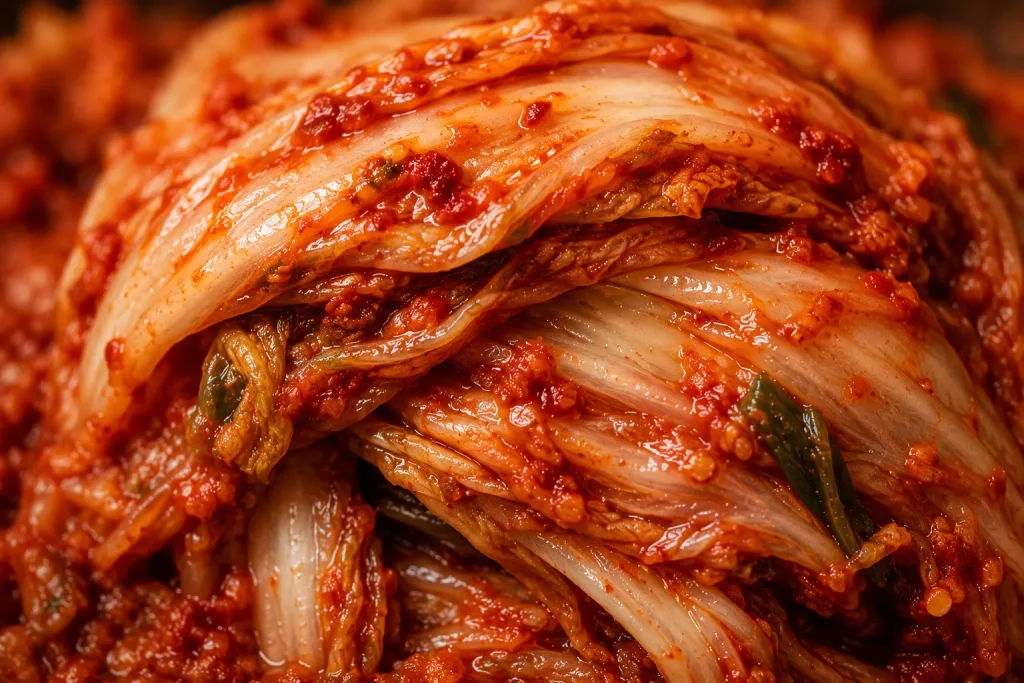
When lactic acid bacteria (LAB) — the dominant microorganisms in kimchi and most Korean fermented foods — go to work on raw ingredients, they do several things simultaneously. Fermentation breaks down proteins into amino acids, including glutamate, which contributes to savory umami taste. Glutamate is the amino acid that activates umami receptors on the tongue — the fifth taste, distinct from sweet, sour, salty, and bitter. When glutamate levels rise, food tastes more fully savory, rounder, deeper. Fresh cabbage has almost none. Aged kimchi has plenty.
Key flavor compounds in kimchi include sugars, organic acids, free amino acids, and volatile compounds, all of which develop during fermentation through the activity of lactic acid bacteria interacting with the raw ingredients. Lactic acid, for instance, is what produces the characteristic sour tang of well-aged kimchi — it’s the same acid in yogurt and sauerkraut, produced here by Lactobacillus plantarum and related bacteria working through the cabbage’s natural sugars.
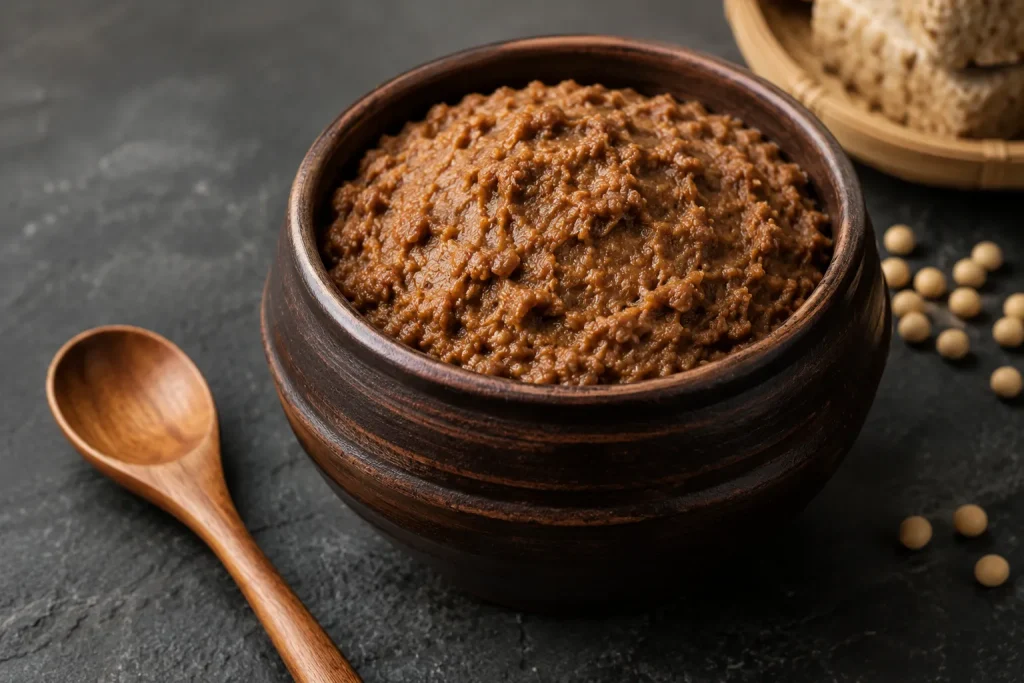
Doenjang, the fermented soybean paste that anchors so many Korean soups and stews, runs a similar process at higher protein concentration. Research has found that doenjang’s umami characteristics result from low-molecular-weight acidic peptides produced naturally during soybean fermentation, with glutamic acid and aspartic acid as the dominant flavor-active compounds. This is why doenjang tastes deeper and more complex than fresh soy — the fermentation is generating flavor molecules that didn’t exist in the raw bean.
And then there’s kokumi — a Japanese-coined term for a quality food scientists describe as “mouthfulness” or flavor continuity, distinct from umami but related. Research from Jeonbuk National University has confirmed that doenjang contains kokumi-active compounds, with positive drivers of kokumi perception including umami, soy sauce aroma, and a smooth mouthfeel. Korean fermented foods aren’t just making things taste savory — they’re making flavors last longer on the palate.
The heat component works differently. Capsaicin — the compound responsible for chili burn — doesn’t activate taste receptors the way glutamate does. It activates pain receptors (TRPV1 channels) that also respond to heat. That’s why spicy food feels warm even when cold. But gochugaru’s capsaicin level is surprisingly moderate. Standard Italian crushed red pepper flakes measure 35,000 to 50,000 Scoville Heat Units, while gochugaru typically sits between 1,500 and 10,000 SHU — designed to add color, sweetness, and layered warmth, not scorching heat. The burn in Korean food is real but restrained. It’s a carrier, not the destination.
To understand how Korean heat compares across the world’s spiciest food cultures, the full ranking of the spiciest cuisines in the world shows exactly where gochugaru sits relative to the chilies used in Thai, Indian, and Mexican cooking — and why Korean cuisine ranks differently than most people expect.
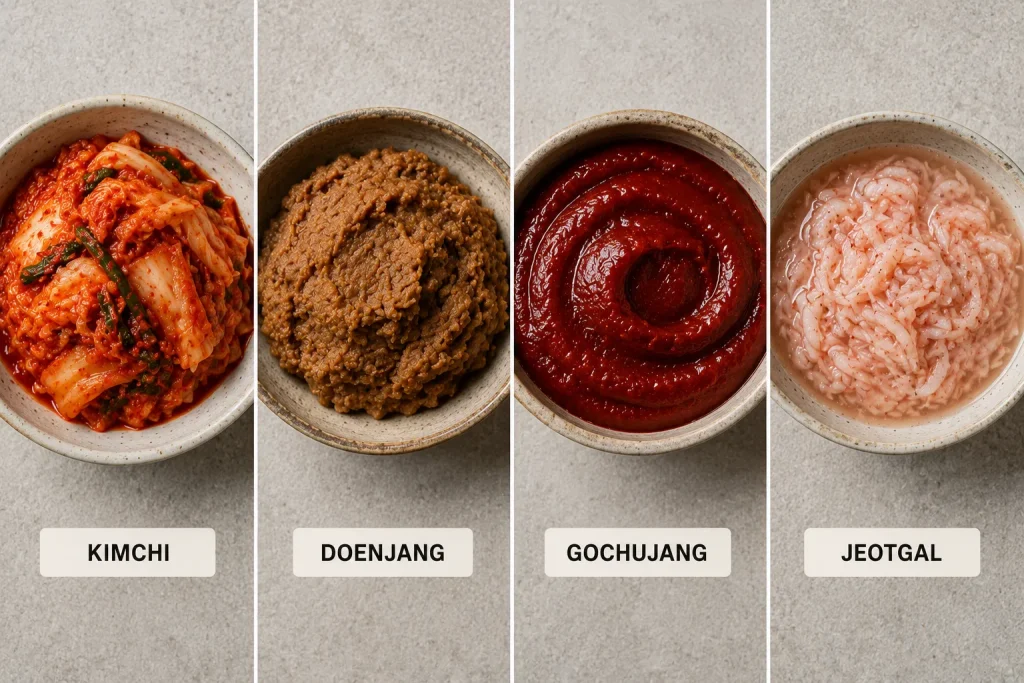
The Four Fermented Pillars That Carry Everything
Kimchi: Fermentation as a Flavor System, Not a Side Dish
Kimchi is not pickled cabbage. That distinction matters more than it sounds. Pickling uses vinegar — an acid applied from outside. Kimchi fermentation works through Lactobacillus plantarum and related lactic acid bacteria already present on the cabbage, which thrive in anaerobic (low-oxygen) conditions inside a closed fermentation vessel, converting carbohydrates into acids and flavor compounds.
The result is a food that evolves over time. Fresh kimchi (geotjeori) is bright, crunchy, and mildly tangy. Kimchi fermented for weeks develops deeper acid and more pronounced umami. Kimchi aged for months — used in kimchi jjigae or kimchi pancakes — is funky, intensely sour, and loaded with glutamic acid. Same cabbage, radically different flavor depending on where in the fermentation timeline you eat it. Korean cuisine uses kimchi at all three stages deliberately, treating time as a seasoning.
Doenjang: The Korean Miso That Isn’t Miso
Doenjang is superficially similar to Japanese miso — both are fermented soybean pastes — but they are genuinely different products with different flavor profiles. Unlike Japanese miso, Korean doenjang does not use koji (a cultivated mold culture); its flavor develops entirely from the natural fermentation of meju, dried fermented soybean blocks, aged through long-term fermentation.
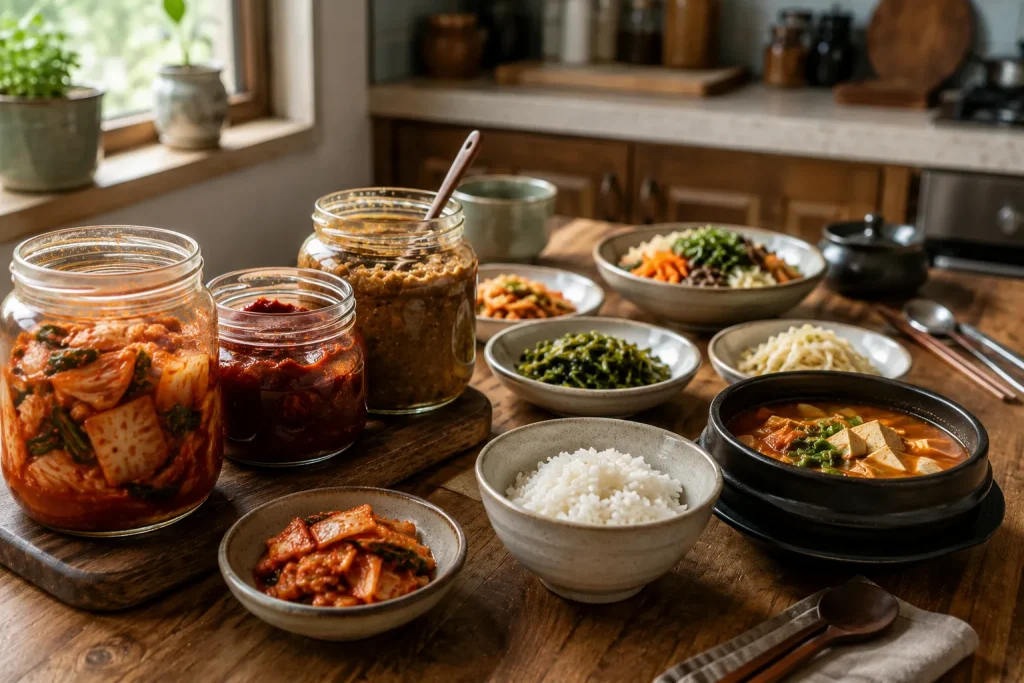
The practical consequence is that doenjang has a funkier, earthier flavor than most misos — less sweet, more assertive. Traditional doenjang is fermented for three to six months, and its color darkens over time due in part to Maillard reaction chemistry, the same browning process that creates flavor in roasted meats and bread crust. Doenjang-jjigae, the soybean paste stew that appears at nearly every Korean meal, is one of the most umami-dense dishes in the cuisine precisely because it concentrates months of microbial flavor work into a single bowl.
Gochujang: Fermented Heat That Builds Rather Than Burns
Gochujang is a case study in why fermentation changes everything about an ingredient. Traditional gochujang fermentation breaks down the starches in glutinous rice into sugars, while lactic acid bacteria and wild yeasts develop the complex flavor profile — this is why gochujang tastes sweet without adding much sugar, and why its heat feels different from fresh chili pastes, with fermentation mellowing the capsaicin while adding depth.
The result is a condiment that tastes simultaneously sweet, spicy, and umami-rich. The sweetness is enzymatic. The heat is capsaicin. The savory depth comes from fermented soybeans in the base. No single ingredient in gochujang produces its characteristic taste — the fermentation process creates it as a new flavor that didn’t exist in the components.
Jeotgal: The Fermented Seafood That Makes Kimchi Work
Jeotgal — salted, fermented seafood — is the least visible but arguably most important ingredient in traditional kimchi. It’s added raw to the kimchi paste before fermentation, and it does two things that nothing else can replicate. Jeotgal contains endogenous enzymes from the muscle and digestive tract of sea animals that promote fermentation and increase the production of abundant free amino acids even under high-salinity conditions. More glutamic acid. More GABA. More of the metabolites that make kimchi taste like more than salted vegetables.
Research measuring the effects of different salted seafoods on kimchi fermentation found that adding jeotgal accelerated acidification and significantly increased glutamic acid and gamma-aminobutyric acid content compared to kimchi made without it. The difference between jeotgal kimchi and vegan kimchi is real and measurable — not a matter of tradition but of chemistry.
Korean Fermentation vs. The World’s Other Fermented Cuisines
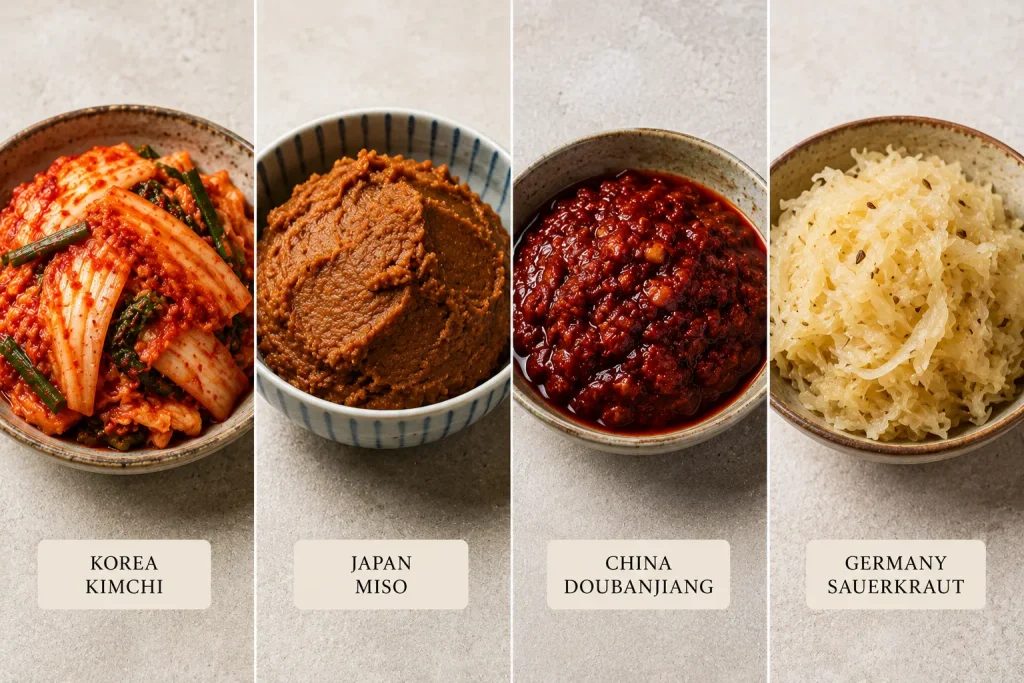
Every major food culture has some fermentation tradition. What makes Korean cuisine distinctive is the degree to which multiple fermented products are combined in a single meal — and the specific interaction between vegetable fermentation and animal-based fermented condiments.
Japanese cuisine has miso, soy sauce, mirin, and sake — all fermented soy or grain products — and uses them with precision. But traditional Japanese fermented condiments don’t typically include fermented fish added directly into vegetable fermentation as an active ingredient the way jeotgal functions in kimchi. The flavor philosophies point in similar directions but travel different routes. Where Japanese cuisine uses umami through controlled precision, Korean cuisine builds it through accumulation and layering across multiple fermented sources simultaneously.
Chinese cuisine has doubanjiang (fermented broad bean paste), black bean paste, and Shaoxing wine. These are powerful fermented condiments, but Chinese cooking tends to use them one at a time as accent flavors rather than layering multiple fermented bases into a single preparation. How China built the world’s most regionally diverse cuisine through different geographic and cultural influences explains why Chinese fermentation developed in this more compartmentalized direction — each region developed its own single signature fermented condiment rather than a stacked system.
German and Eastern European fermented foods — sauerkraut, pickled beets, kvass — share the lactic acid bacteria foundation with kimchi, but they’re generally simpler: one vegetable, one microbial process, one flavor note. The Korean tradition is more compositionally complex, stacking garlic, ginger, chili, seafood, and vegetables into a single fermentation vessel.
The closest parallel in flavor intensity might be Southeast Asian cuisine — Vietnamese, Thai, and Filipino food all rely heavily on fish sauce (which shares jeotgal’s glutamate-generating amino acid hydrolysis). But those cuisines use fish sauce as a finished condiment, not as an active ingredient in ongoing fermentation. As explored in why Vietnamese food tastes so fresh, fish sauce in Vietnamese cooking provides the invisible umami backdrop against which raw herbs and fresh aromatics register so vividly — the opposite structural role to how jeotgal operates inside kimchi’s fermentation vessel. The Korean approach is to use fermented ingredients to create more fermentation — a compounding effect that goes deeper than any single condiment can.
Similarly, why Thai food balances flavors so effectively comes down to integrating fish sauce, lime, sugar, and chili into a unified balance within the dish. Korean cuisine instead separates those elements across multiple fermented condiments and layers them at the table.
What Knowing This Changes in Your Kitchen
The most transferable insight from Korean fermentation science is this: time is a flavor ingredient, and it works differently from salt, acid, or heat. You can’t rush fermentation. But you can use aged Korean fermented ingredients — doenjang, gochujang, aged kimchi — to add weeks of flavor work to a dish in seconds.
A spoonful of doenjang stirred into a beef stew adds glutamic acid, Maillard-browned soybean compounds, and kokumi depth that you simply cannot get from fresh ingredients. A tablespoon of gochujang in a tomato sauce adds sweetened, fermented chili heat that no fresh pepper can replicate. Kimchi as a condiment on a grilled cheese sounds wrong until you realize that the lactic acid in aged kimchi does exactly what well-made sourdough does — cuts through fat and adds complexity.
The common home cook mistake is treating Korean fermented condiments as seasoning agents (add a little to taste) rather than flavor foundations (build the dish around them). Doenjang jjigae is not doenjang-seasoned vegetable soup. The doenjang is the dish.
Next time you eat well-made kimchi, pay attention to the moment after the sourness. There’s a savory, lingering quality that arrives a beat behind the acid. That’s the glutamic acid from fermentation — the umami backbone that developed over days or weeks in the fermentation vessel. Once you can identify it, you’ll taste it in every Korean dish that uses aged kimchi, doenjang, or gochujang. And you’ll know exactly what produced it.
The Regional Variations That Complicate the Story
The idea that Korean food equals fiery heat is more of a central and southern Korea thing. Regional variation in Korean cuisine is real and significant.
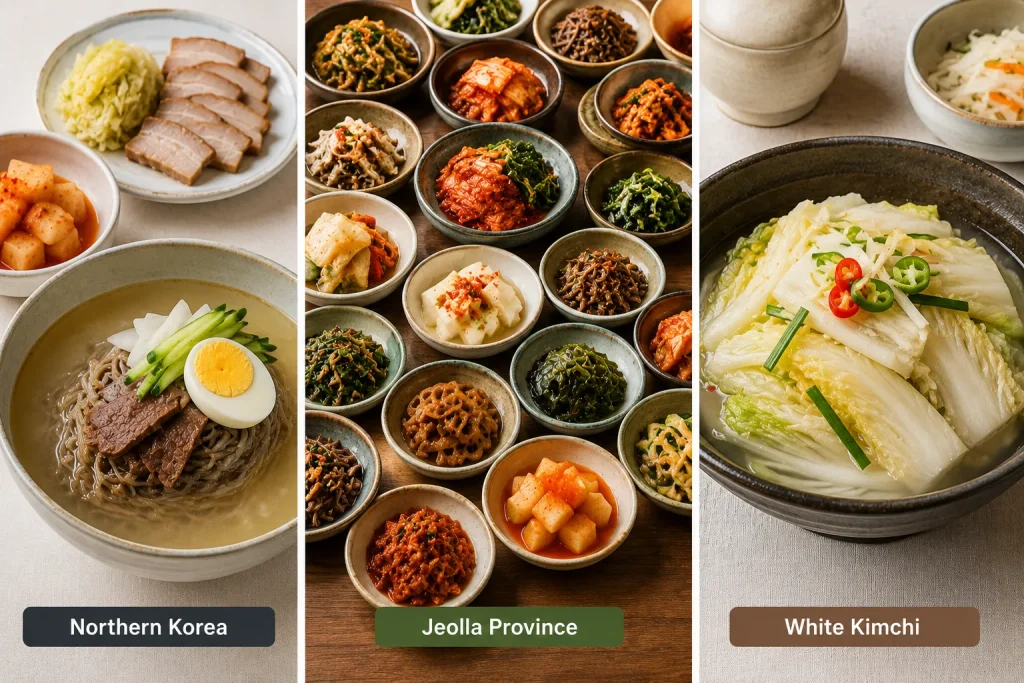
Northern Korean cuisine — historically from areas now in North Korea — traditionally used less gochugaru and leaner preparations. The harsher northern climate meant different agricultural outputs, and the food reflects that: lighter, less pungent, with doenjang and fermented vegetables playing larger roles than chili heat. The spicy-equals-Korean shorthand comes largely from southern Gyeongnam and Jeolla province food, which traveled globally via the Korean diaspora and the postwar restaurant culture.
Jeolla province (the southwestern region) is particularly regarded within Korea as the country’s culinary heartland. Jeonju bibimbap and the broader Jeolla tradition of banchan (side dish) abundance reflects a region with rich agricultural land and a culture of elaborate, layered meals. The fermentation traditions here are more developed and diverse than in the north or the eastern coastal provinces.
Baek-kimchi (white kimchi, made without gochugaru) is a reminder that kimchi predates chili peppers in Korea. Pre-16th-century kimchi was fermented, salty, and garlicky but not spicy. Baek-kimchi, still made today, is a direct descendant of that tradition — and its flavor is surprisingly complex given the absence of the ingredient most people consider essential.
The Bottom Line
Korean food is flavorful because it layers fermentation on fermentation. The kimchi on your table isn’t just a condiment — it’s weeks of lactic acid bacteria converting cabbage sugars into acids and amino acids. The doenjang in the soup is months of soybean fermentation generating glutamic acid and kokumi-active peptides. The gochujang in the sauce is fermented, enzymatically sweetened, capsaicin-forward depth that took time to become itself.
None of these flavors exist in the raw ingredients. Fermentation manufactures them. That’s the mechanism behind the intensity, the complexity, and the lingering quality that makes Korean food memorable. The heat is real, but it’s a supporting actor. The fermentation is the plot.
Eat a bowl of doenjang jjigae next time and sit with the aftertaste. That long, round, savory finish isn’t the miso paste hitting your tongue. It’s 1,300 years of fermentation science doing exactly what it was designed to do.
People Also Ask
Why does Korean food taste so strong and complex?
Korean cuisine’s intensity comes from stacking multiple fermented ingredients — kimchi, doenjang, gochujang, jeotgal — each of which contains high levels of glutamic acid and other flavor-active compounds produced by lactic acid bacteria during fermentation. These compounds activate umami receptors and create a flavor depth that raw ingredients cannot produce. The combination of several fermented elements in a single meal compounds that effect significantly.
What makes Korean fermentation different from Japanese or Chinese fermentation?
Korean fermentation is distinctive because it uses fermented animal-based ingredients (jeotgal, fermented seafood) as active ingredients inside vegetable fermentation, not just as condiments added afterward. Kimchi is potentially the only fermented food in the world that uses fermented fish sauce to actively ferment vegetables. Japanese fermentation tends to rely on soy and grain-based products; Chinese fermentation uses powerful condiments but typically one at a time rather than stacked.
Is Korean food actually that spicy, or is it a misconception?
It’s partly a misconception. Gochugaru, the primary heat source in Korean cooking, measures 1,500 to 10,000 Scoville Heat Units — significantly milder than Italian crushed red pepper flakes (35,000 to 50,000 SHU). Korean food can be genuinely spicy in certain dishes, but gochugaru is primarily used for color, smokiness, and warmth rather than scorching heat. The perception of intense spice often comes from the combination of heat with strong fermented flavors, not from extreme capsaicin levels.
Why does kimchi taste different depending on how old it is?
Fermentation is a living process. Fresh kimchi is bright and lightly tangy because the lactic acid bacteria have had little time to produce acids and amino acids. As fermentation progresses over weeks and months, lactic acid concentration increases (producing the sour flavor), and protein breakdown generates more glutamic acid (umami). Older kimchi used in cooking — kimchi jjigae, kimchi pancakes — is deliberately aged because its complex, funky, concentrated flavor improves under heat in ways that fresh kimchi doesn’t.
What is doenjang and why is it so important in Korean cooking?
Doenjang is a traditional Korean fermented soybean paste made from meju (naturally fermented soybean blocks) aged with brine for months. Unlike Japanese miso, which uses a cultivated mold culture (koji), doenjang ferments entirely through natural microbial activity. Research has shown its umami characteristics come from low-molecular-weight acidic peptides, primarily glutamic and aspartic acid, produced during fermentation. Koreans consume it in the form of soup regularly — doenjang jjigae is a daily staple at the Korean table in the same way miso soup is in Japan.
Why does Korean barbecue taste so good with fermented condiments?
Korean barbecue is typically served with ssamjang — a mix of doenjang and gochujang — and accompanied by aged kimchi. The fat from grilled pork or beef carries its own flavor compounds, and the fermented condiments provide glutamate, lactic acid, and capsaicin that contrast the richness. The combination works because fat and fermented acid are naturally complementary — the acidity of kimchi cuts through grilled fat exactly the way a wine with acidity balances a fatty dish. The science behind Korean barbecue pairings is the same as the science behind European cheese and wine.
Can you get the same fermented flavor at home without waiting weeks?
Not exactly, but aged Korean fermented condiments bought from a Korean grocery store carry the same compounds as traditionally fermented homemade versions — the fermentation happened at the factory or by the producer. Using good-quality doenjang, gochujang, and well-aged kimchi in cooking gives you access to the months of fermentation work already done. The key shift is using them as flavor bases rather than seasonings — building a sauce from doenjang rather than adding it as a finishing note — which is how Korean home cooking actually uses them.
Sources and References
- Frontiers in Microbiology (2016) — Han, K.J. et al. “Kimchi and Other Widely Consumed Traditional Fermented Foods of Korea: A Review.” Frontiers in Microbiology, 7, 1493. Read on Frontiers
- ScienceDirect — Food Chemistry (2011) — Ro, S. H. et al. “Umami taste characteristics of water extract of Doenjang, a Korean soybean paste: Low-molecular acidic peptides may be a possible clue to the taste.” Food Chemistry, 127(3), 1210–1215. Read on ScienceDirect
- ScienceDirect — Food Science and Human Wellness (2015) — “Korean traditional fermented soybean products: Jang.” Food Science and Human Wellness, 4(1), 1–7. Read on ScienceDirect
- ScienceDirect — Food Bioscience (2018) — Kim, E. et al. “Role of jeotgal, a Korean traditional fermented fish sauce, in microbial dynamics and metabolite profiles during kimchi fermentation.” Food Bioscience, 22, 163–170. Read on ScienceDirect
- ScienceDirect — Postharvest Biology and Technology (2025) — “Flavor compound profiles and enhancement strategies in the kimchi-making process.” Read on ScienceDirect
- PRNewswire / Jeonbuk National University (2025) — “Researchers Explore the Impact of Different Seasonings on the Flavor Perception of Doenjang Soup.” Read on PRNewswire