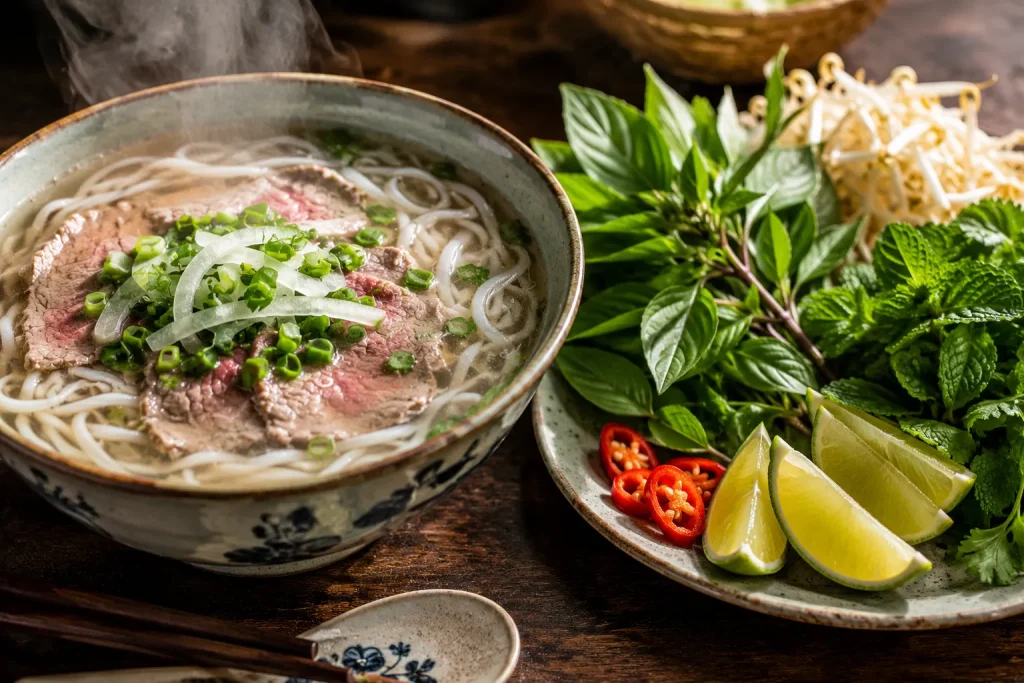
China did not set out to build eight distinct culinary traditions. Geography did that. A country spanning tropical coastlines, high-altitude plateaus, semi-arid plains, and river deltas so fertile they fed dynasties for millennia could not possibly produce a single cuisine the ingredients available in Chengdu and the ingredients available in Guangzhou are, in many cases, more different from each other than either is from the food of neighboring countries.
Understanding why Chinese food varies so dramatically by region means understanding one of the most important facts in culinary geography: regional Chinese cuisines are not variations on a theme. They are independent flavor systems that share a writing system and a cooking vessel.
Why Chinese Food Varies So Much by Region
- China’s north-south climate divide is more extreme than the entire European continent, creating agricultural conditions that produce fundamentally different staple ingredients wheat in the north, rice in the south.
- The Sichuan Basin’s geographic isolation allowed a distinct flavor culture to develop around locally produced spices, particularly the Sichuan peppercorn, whose numbing compound has no equivalent in any other regional cuisine.
- Cantonese cuisine developed its restraint and freshness-first philosophy partly because Guangdong’s subtropical climate and Pearl River Delta waterways gave cooks year-round access to live seafood and produce preservation techniques that shaped northern and inland cuisines were simply less necessary.
- China’s historical trade routes moved spices, chili peppers, and fermentation cultures across regions unevenly, so different areas absorbed outside influences at different rates and in different combinations.
- Imperial food culture concentrated culinary expertise in regional capitals, and when those capitals became commercial hubs, their local cooking styles became the dominant export cuisine of their region.
Why the Yangtze River and the Yellow River Explain More Than Any Recipe
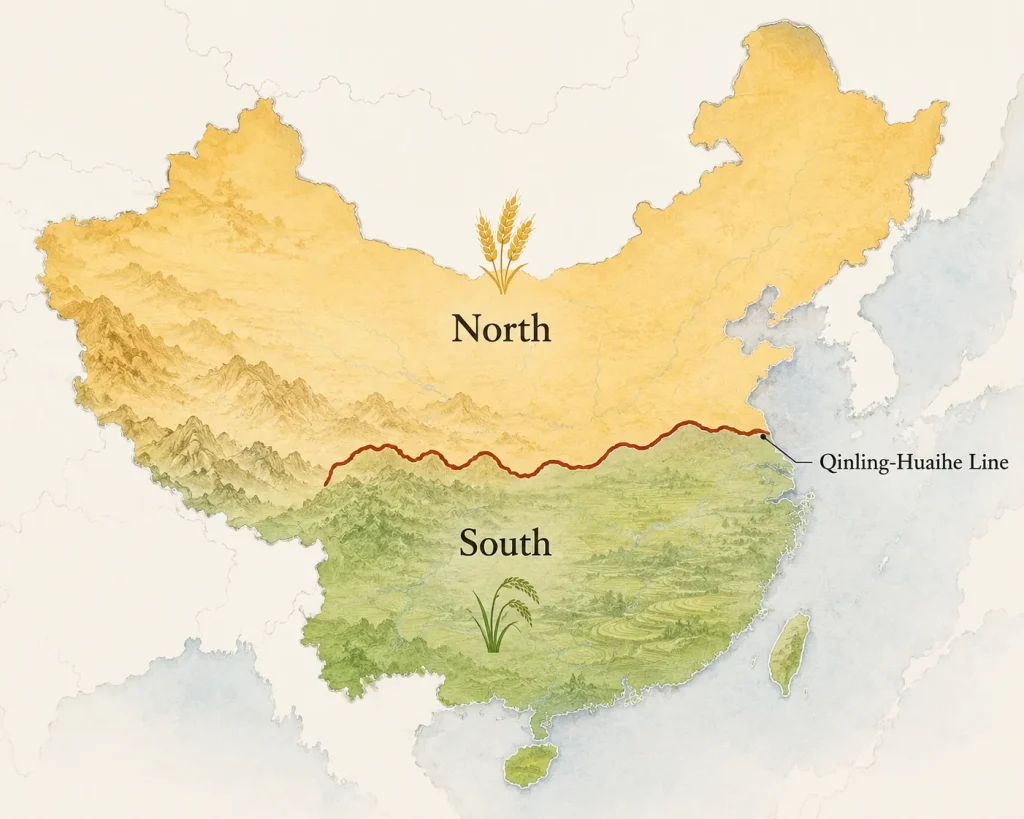
The single most important geographic fact in Chinese culinary history is the Qinling-Huaihe Line an invisible boundary running roughly east-west across the middle of the country that separates China’s wheat-growing north from its rice-growing south.
This boundary is not political. It is climatic. North of the line, rainfall is insufficient for rice cultivation and winter temperatures make year-round fresh produce impossible. The result: a cuisine built around wheat-based noodles and dumplings, preserved vegetables, lamb and beef from pastoral northern traditions, and the umami depth of fermented wheat pastes like doubanjiang’s northern equivalent, dried yellow soybean paste.
South of the line, the story reverses. The Yangtze River Delta and Pearl River Delta produce two or three rice harvests annually. Fresh vegetables are available through most of the year. The flavor philosophy that follows from abundance looks very different from the flavor philosophy that follows from scarcity and cold storage.
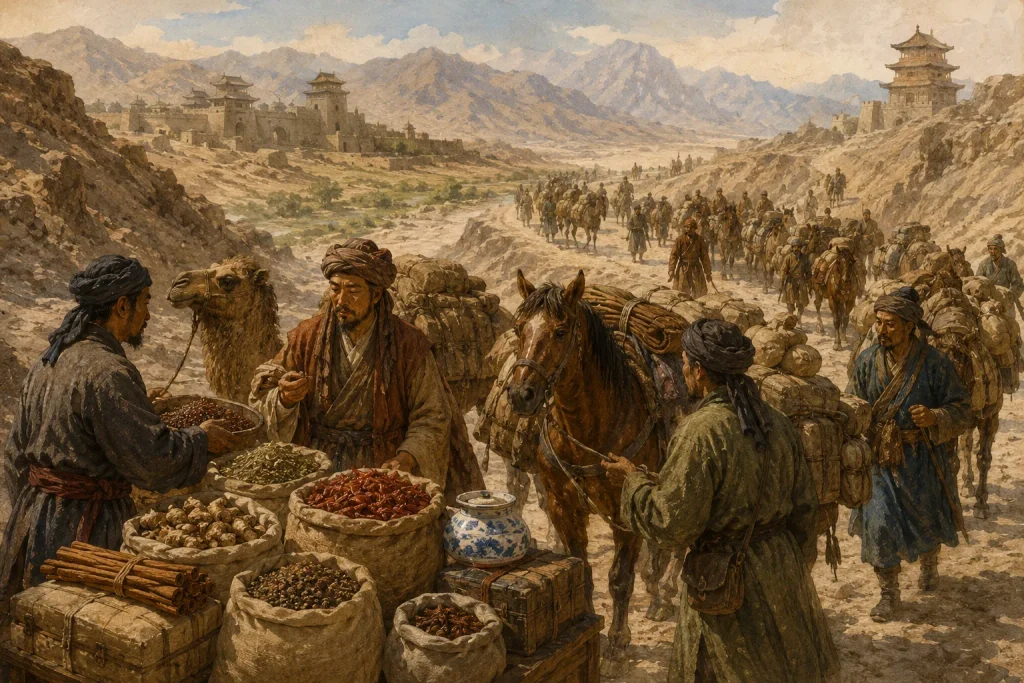
The Silk Road added another layer. Beginning in the Han Dynasty and intensifying under the Tang, trade routes brought Central Asian spicing traditions cumin, sesame, lamb preparations into Xinjiang and Shaanxi in ways that never reached Fujian or Zhejiang. China did not receive outside culinary influences uniformly. It received them through whichever geographic corridor those influences traveled through, and they stayed there.
The Ming and Qing dynasty administrative structures reinforced this fragmentation. Regional governors maintained distinct courts with distinct culinary staffs. When a Shandong-style cook served at the imperial court in Beijing, Shandong cuisine gained prestige. When Cantonese merchants dominated southern trade, their food culture spread along trade routes radiating out from Guangzhou. Political and economic power shaped which cuisines became dominant within their regions and which cuisines were exported to the diaspora.
What Is Actually Happening on Your Tongue When You Eat Across China’s Regions
The diversity of Chinese regional cuisine is not simply about different ingredients. It reflects four distinct flavor-building strategies that operate on different chemical and sensory principles.
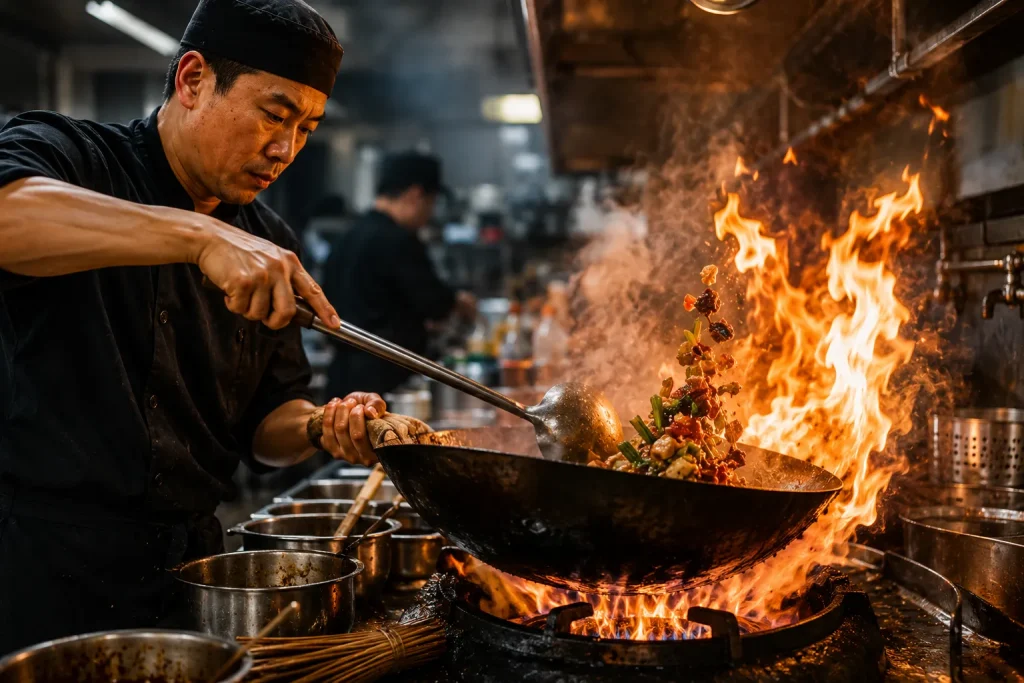
Maillard-forward cooking dominates in Beijing and Shandong cuisine. The Maillard reaction the chemical process by which proteins and sugars react under high heat to produce hundreds of new flavor compounds is maximized in the wok cooking technique called baochao, meaning explode-fry. Temperatures exceeding 300 degrees Celsius create browning reactions in seconds that produce the smoky, caramelized depth known as wok hei, literally “breath of the wok.” The flavor compounds produced include pyrazines and furans, the same classes of compounds responsible for the aroma of roasted coffee and bread crust.
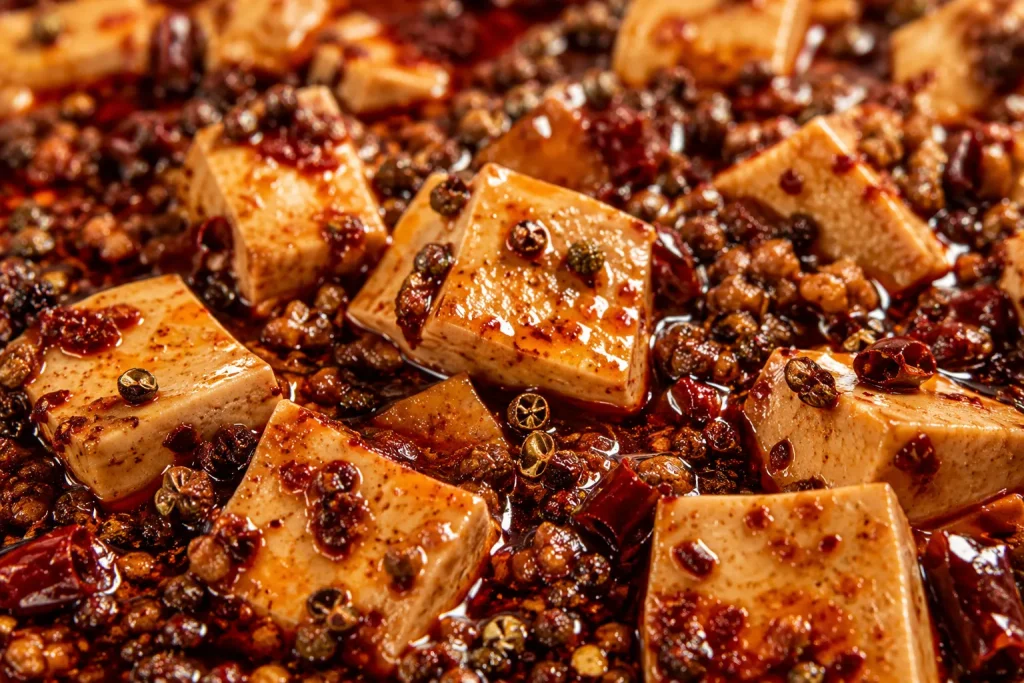
Capsaicin and hydroxy-alpha-sanshool create the defining experience of Sichuan cuisine. Capsaicin the compound in chili peppers that triggers heat receptors in the mouth arrived in China from the Americas via Portuguese and Spanish trade routes in the 16th century. Sichuan cooks combined it with the Sichuan peppercorn, which contains hydroxy-alpha-sanshool, a compound that activates low-threshold mechanoreceptors in the mouth, creating the tingling, numbing sensation called ma (numbing) that combines with the chili’s la (heat) to produce mala a flavor experience with no close equivalent in any other major cuisine. The combination does not simply add heat to numbness. The sanshool actually lowers the threshold at which capsaicin triggers heat sensation, making the heat feel more intense and more diffuse simultaneously.
Glutamate accumulation through fermentation and slow cooking is the engine behind Shanghai and Huaiyang cuisine. Fermented soybean products, slow-braised meats, and the technique of hongshao (red braising cooking proteins low and slow in soy sauce, Shaoxing wine, and sugar) build glutamate the amino acid responsible for umami through protein breakdown over hours. The result is a deep, almost sweet savory depth that cannot be rushed. Collagen from pork belly converts to gelatin, creating the gelatinous texture of dongpo pork. The glutamate concentration in a properly made red-braised sauce is comparable to aged Parmesan.
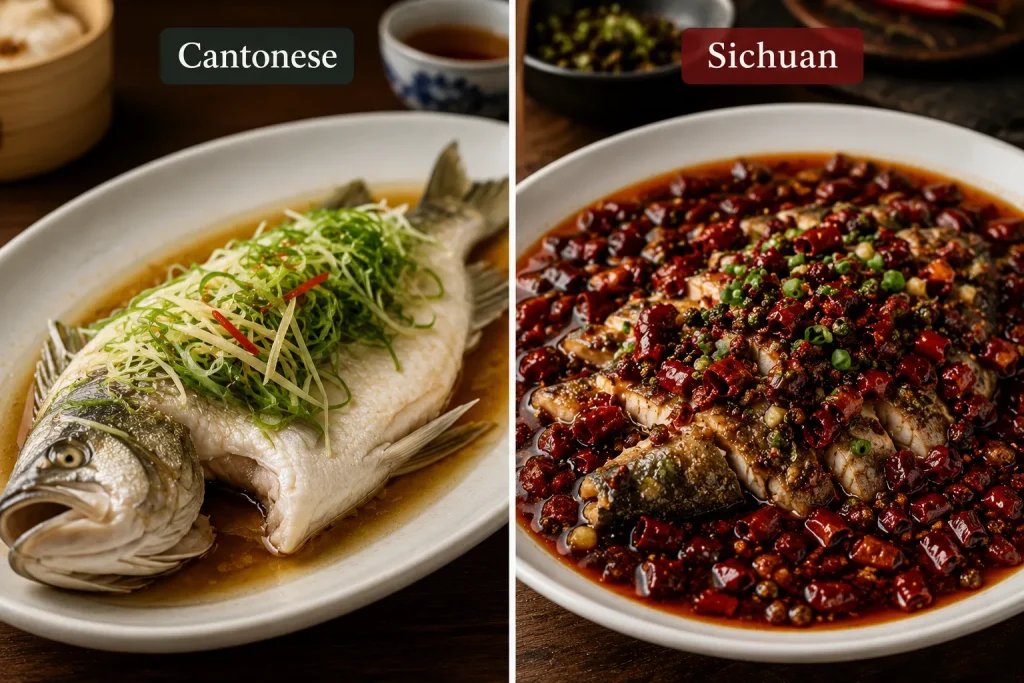
Restraint and freshness amplification defines Cantonese technique. Cantonese cooks use minimal seasoning not because they lack flavor complexity, but because the technique is designed to amplify the flavor already present in the ingredient. Steaming fish with ginger and scallion, then finishing with hot oil and soy sauce, is not simple cooking. It is a precision technique that uses aromatics to remove unwanted fishiness while a brief burst of hot oil blooms the scallion and ginger flavor compounds largely fat-soluble into the dish in seconds. The soy sauce provides glutamate. The result tastes intensely of the fish because everything else was engineered to get out of its way.
The Ingredients and Techniques That Carry Each Regional Identity
Sichuan Peppercorn: The Compound That Made a Cuisine
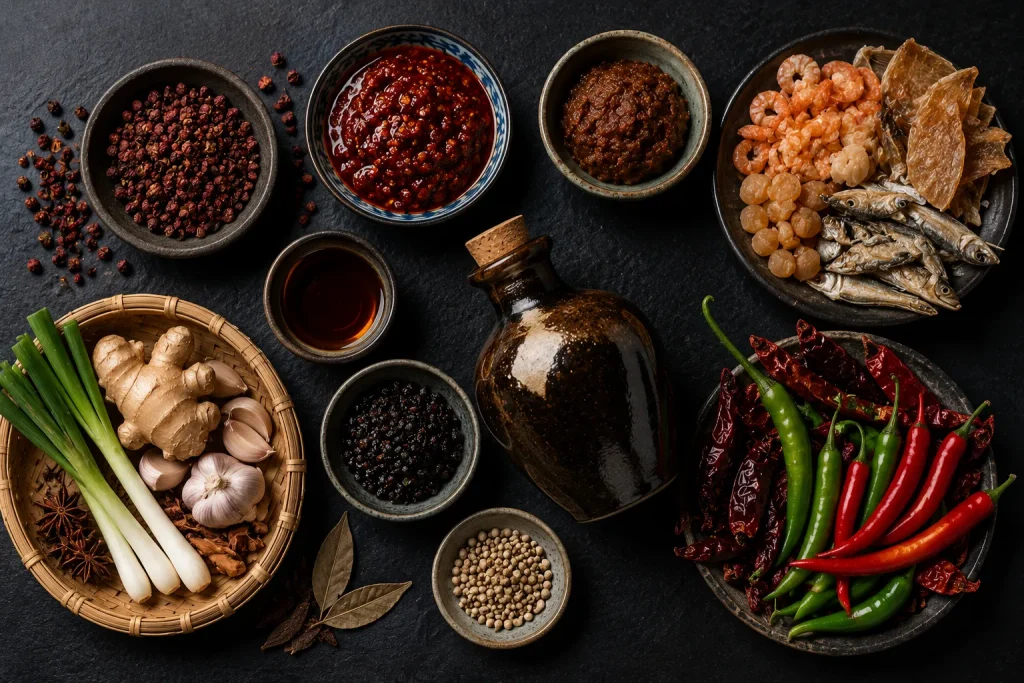
The Sichuan peppercorn is not a pepper. It is the dried husk of the prickly ash shrub, and its active compound, hydroxy-alpha-sanshool, works on the nervous system rather than heat receptors, producing a tingling paralysis of the lips and tongue that Sichuan cooks describe as the essential prerequisite for the full mala experience. Without the numbness, chili heat in Sichuan food would simply be overwhelming. The sanshool moderates and diffuses it. Sichuan peppercorn is used toasted and ground as a finishing spice, infused in oil, and cooked whole into braises. Its citrus-floral top notes, which dissipate quickly with heat, are the reason finishing applications produce a noticeably different flavor than early-cooking applications.
Doubanjiang: The Fermented Paste That Defines Sichuan Umami
Doubanjiang fermented broad bean and chili paste is the foundational umami source in Sichuan cooking and one of the most flavor-dense fermented products in any cuisine. Pixian doubanjiang, aged for one to three years in clay pots, develops a glutamate concentration through protein fermentation that gives Sichuan braises and stir-fries their characteristic savory depth beneath the heat. The paste is almost always fried in oil first a technique that blooms its fat-soluble aroma compounds and deepens its color from brick-red to dark mahogany before any other ingredient enters the wok.
Wok Hei: The Technique That Northern and Eastern Cuisines Built Around
Wok hei is the smoky, slightly charred breath that high-heat wok cooking imparts. It requires a carbon-steel wok seasoned over hundreds of uses, a burner powerful enough to maintain extreme heat even when cold ingredients hit the surface, and the cooking speed to move ingredients constantly so they brown without steaming. The flavor compounds primarily pyrazines are volatile. They begin dissipating within minutes of leaving the wok. This is why restaurant wok cooking tastes different from home wok cooking: commercial burners produce three to five times the BTU output of residential ranges, sustaining the temperature needed to generate wok hei even when a full portion of ingredients drops the surface temperature.
Shaoxing Wine: The Fermented Base of Eastern Chinese Flavor
Shaoxing rice wine, produced in Zhejiang province from glutinous rice fermented in local water, appears in Shanghai, Hangzhou, and Suzhou cooking the way wine appears in French cooking as both a cooking medium and a flavor foundation. Its role is not primarily alcoholic. The fermentation produces organic acids, esters, and amino acids that round the flavor of braised meats, balance the sweetness of red-braised dishes, and provide a specific aromatic depth that is not replicated by sake or dry sherry, despite frequent substitution suggestions. In hongshao preparations, Shaoxing wine is added before soy sauce so its alcohol can help dissolve and carry fat-soluble flavor compounds from the meat.
Cantonese Velveting: The Protein Technique That Changed Texture
Velveting coating proteins in a slurry of egg white, cornstarch, and sometimes bicarbonate before brief poaching or oil blanching is a Cantonese technique that solves a specific problem: how do you cook protein quickly enough for stir-frying without toughening it? The cornstarch forms a protective barrier that slows moisture loss, the egg white sets into a thin coating that stays tender, and the rapid pre-cooking partially sets the protein at a low enough temperature to prevent toughening. The result is the silky, yielding texture that distinguishes Cantonese stir-fried proteins from the chewier textures of cuisines that skip this step.
Key Ingredients Across China’s Major Regional Cuisines
| Region | Defining Ingredient | Key Technique | Flavor Profile | Signature Dish |
|---|---|---|---|---|
| Sichuan | Doubanjiang, Sichuan peppercorn | Mala stir-fry, red braising | Numbing, fiery, fermented-savory | Mapo tofu, kung pao chicken |
| Cantonese | Fresh seafood, oyster sauce | Steaming, velveting, flash stir-fry | Clean, sweet-savory, ingredient-forward | Steamed fish, dim sum |
| Shandong | Fermented yellow soybean paste | High-heat wok, slow braising | Savory-deep, mellow, wheat-forward | Sweet and sour carp, dezhou braised chicken |
| Shanghai/Huaiyang | Shaoxing wine, soy sauce, sugar | Red braising (hongshao) | Sweet-savory, rich, gelatinous | Dongpo pork, lion’s head meatballs |
| Hunan | Fresh chili, fermented black beans | Stir-frying with wet heat | Pure heat, sour-sharp, punchy | Chairman Mao’s red-braised pork |
| Fujian | Dried seafood, rice wine | Red fermented tofu braises, soups | Umami-oceanic, subtle, layered | Buddha Jumps Over the Wall |
| Xinjiang | Cumin, lamb, sesame | Open-fire grilling, pilaf | Smoky, spiced, Central Asian | Hand-pulled noodles with lamb, polo rice |
| Beijing | Fermented pastes, sesame | Northern braising, wheat-based | Robust, paste-forward, hearty | Zhajiangmian, Peking duck |
How Other Cuisines Handle Flavor Diversity — And Why China’s Case Is Different
Most large countries with regional culinary variation produce cuisines that share a recognizable national flavor identity even at their most divergent. Italian regional cuisines from Piedmont’s butter-forward north to Sicily’s Arab-influenced south share a structural commitment to ingredient quality and restraint. Indian regional cuisines vary enormously in spice use, but the underlying logic of tempering whole spices in fat appears from Kerala to Kashmir.
Chinese regional cuisines are unusual because some of their defining principles are genuinely incompatible rather than just different. The Cantonese commitment to freshness and minimal intervention is not a variation on the Sichuan commitment to flavor transformation through fermentation, chili heat, and numbing spice. They are opposite philosophies about what cooking is for.
The closest parallel is the culinary geography of the Mediterranean, where Greek, Lebanese, Spanish, and Moroccan cuisines share access to similar ingredients but have built entirely different flavor systems around them. But even that comparison understates the Chinese case, because those Mediterranean cuisines developed across genuinely different countries, languages, and cultural histories. Chinese regional cuisines developed within a single political and linguistic civilization the diversity is internal.
This is what makes Chinese culinary geography remarkable: the same civilization produced flavor systems as different from each other as French and Thai cooking, within borders that never stopped being China.
What Understanding This Changes in Your Kitchen
The most practical insight this article offers is also the most underappreciated one: Chinese cooking techniques are not interchangeable, and using the wrong technique for a dish’s regional origin explains most of the failures in home Chinese cooking.
If you are making a Cantonese dish steamed fish, stir-fried greens, any dim sum preparation the technique demands speed, high heat, and restraint with seasoning. If you season it like a Sichuan dish, you have not made a spicier Cantonese dish. You have made something that does not exist in either cuisine.
The single most transferable technique from Chinese cooking to general home cooking is velveting. Any protein chicken, beef, pork, even firm tofu treated with an egg white and cornstarch coating before brief poaching becomes noticeably more tender in stir-fries. This technique requires nothing exotic and solves the most common problem in home stir-frying: meat that toughens before the vegetables are cooked.
The common mistake that understanding regional variation corrects: adding chili or Sichuan peppercorn to a dish from a non-Sichuan region because “that’s what Chinese cooking tastes like.” Cantonese, Shanghainese, and Fujianese cooking do not use these spices as primary flavors. Applying them universally flattens the genuine diversity this article is about.
Next time you eat Cantonese food, try to taste the ingredient itself the fish, the shrimp, the vegetable rather than a sauce applied to it. If the cooking is correct, the ingredient should taste more intensely like itself than it would raw.
The Regional Variations That Make This Story More Complicated
Even within China’s eight major culinary traditions, the story resists clean categorization.
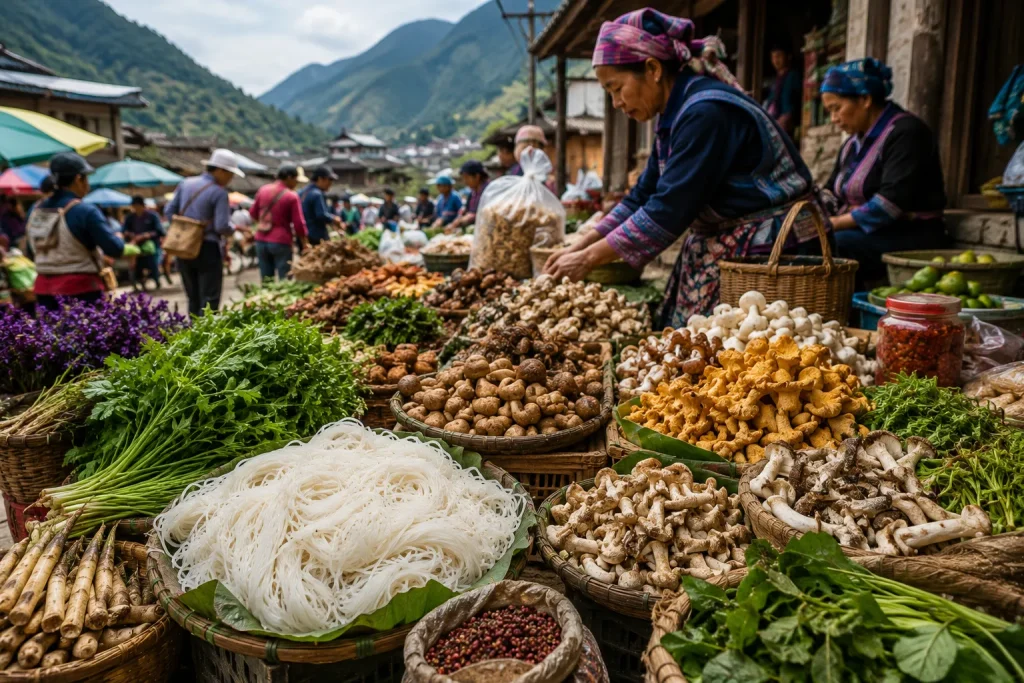
Yunnan cuisine challenges the north-south rice-wheat divide entirely. Sitting at high altitude in southwestern China, Yunnan has developed a cuisine shaped by its position at the intersection of Southeast Asian, Tibetan, and Han Chinese culinary influences using ingredients like wild mushrooms, rice noodles, and cured meats that have more in common with neighboring Myanmar and Laos than with the Sichuan Basin immediately to its north. Crossing Tree Root Bridge noodles and steam pot chicken reflect a cooking logic that belongs to no standard regional category.
Hakka cuisine complicates geographic determinism by following a people rather than a place. The Hakka are a Han Chinese subgroup whose history of migration across southern China over centuries produced a cuisine built around preservation fermented mustard greens, salt-baked meats, and tofu preparations designed for long shelf life and portability. Hakka cooking appears in Guangdong, Fujian, and across the Chinese diaspora in Southeast Asia, carrying consistent flavor principles across radically different local environments.
Even Sichuan’s mala identity is not uniform. Chongqing, administratively separate from Sichuan since 1997, has developed a hotter, more aggressively oil-forward version of mala cooking that Sichuan chefs sometimes describe as a related but distinct tradition. The distinction is specific enough that restaurant menus in China distinguish Chongqing hot pot from Sichuan hot pot as different products.
The Bottom Line
Chinese regional cuisine is diverse not because China tried to create variety but because geography, climate, trade history, and the agricultural logic of a continent-sized country made a single cuisine impossible. The wheat eater in Shaanxi and the rice farmer in Guangdong were not making different choices about flavor. They were responding to what their land gave them, and over centuries those responses became cuisines.
What this means for anyone eating Chinese food is that ordering “Chinese food” is approximately as specific as ordering “European food.” The next dish you eat from a regional Chinese kitchen whether it is the clean restraint of a Cantonese steam or the layered numbing heat of a Sichuan braise is the product of a specific place with a specific agricultural history and a specific set of solutions to specific culinary problems. Tasting it with that knowledge is a different experience from tasting it without it.
The food does not change. What changes is that you know what you are tasting.
People Also Ask
Why does Chinese food taste so different from region to region?
China’s regional cuisines differ because the country’s extreme geographic range spanning tropical coasts, temperate river valleys, arid northern plains, and high-altitude interiors produces fundamentally different agricultural systems. Regions that grow different staples, raise different animals, and have access to different wild ingredients develop different flavor systems over centuries. Trade route geography means different regions absorbed outside influences like chili peppers, cumin, and Central Asian spice traditions at different rates and through different pathways, deepening the divergence.
What are the main regions of Chinese cuisine and how are they different?
The most commonly referenced framework identifies eight major regional cuisines: Sichuan (numbing and spicy), Cantonese (fresh and restrained), Shandong (savory and wheat-forward), Huaiyang/Shanghai (sweet-savory and slow-braised), Hunan (purely hot and sour-forward), Fujian (oceanic and umami-rich), Anhui (wild ingredient and game-forward), and Zhejiang (fresh and delicate). The differences are not merely about spice levels. They reflect different techniques, different staple ingredients, different preservation traditions, and different underlying philosophies about what cooking should do to an ingredient.
What makes Sichuan food so spicy and numbing compared to other Chinese cuisines?
Sichuan cuisine’s mala character comes from two distinct compounds working together. Capsaicin from chili peppers — which arrived in Sichuan from the Americas in the 16th century via trade routes — provides heat. Hydroxy-alpha-sanshool from the native Sichuan peppercorn activates mechanoreceptors in the mouth, creating numbness and tingling. The combination is not simply additive. The sanshool appears to lower the threshold at which capsaicin triggers heat sensation, creating a diffuse, whole-mouth experience that is distinct from the localized burn of chili heat alone. No other major Chinese regional cuisine developed this specific combination.
Why does Cantonese food taste so different from Sichuan or Shanghai food?
Cantonese cuisine’s restraint reflects the conditions in which it developed. Guangdong’s subtropical climate and Pearl River Delta waterways historically gave Cantonese cooks year-round access to live seafood and fresh produce that cooks in colder, more landlocked regions could not rely on. The Cantonese flavor philosophy minimal seasoning designed to amplify the ingredient’s own flavor rather than transform it is a rational response to having exceptional ingredients available. When you can get a live fish from a tank and steam it within the hour, adding heavy fermented pastes or chili heat would bury what makes the ingredient worth using.
Is MSG just a shortcut for traditional Chinese cooking?
This is a widespread misconception. MSG monosodium glutamate, the pure salt form of glutamate was isolated and named by Japanese chemist Kikunae Ikeda in 1908, but the glutamate it delivers is the same compound that Chinese cooking had been building through fermentation for centuries. Doubanjiang, fermented soy sauce, dried seafood, and slow-braised meats all work partly by accumulating free glutamate through protein breakdown. MSG is a shortcut to the same chemical outcome, not a substitute for a different flavor. The distinction matters because it clarifies what traditional Chinese fermentation techniques are actually accomplishing at a molecular level.
Why does Chinese restaurant food taste different from Chinese food in China?
The biggest factor is ingredient quality and sourcing. Chinese cooking in China, particularly Cantonese and Fujianese seafood cooking, relies heavily on extremely fresh or live ingredients that are expensive or unavailable in Western markets. A Cantonese steamed fish made with a fish that was swimming two hours ago tastes different from one made with a fish that was frozen and thawed, regardless of technique. The second factor is equipment: restaurant wok burners in China operate at heat levels that most Western commercial kitchens do not match, making true wok hei difficult to replicate. Regional dishes are also often adjusted for local palates outside China, moderating heat, sweetness, or fermented flavors.
What is the most important technique in Chinese cooking?
There is no single answer because the most important technique varies by region. For Cantonese cooking, mastery of steaming and velveting is foundational. For Sichuan cooking, the ability to fry fermented pastes in oil to bloom their flavor compounds without burning them is essential. For Shanghai cooking, controlling the balance of soy, wine, and sugar in red braises over low heat for extended periods defines the cuisine. If forced to choose one technique that transfers across the most Chinese regional traditions, high-heat wok cooking and the temperature management that makes wok hei achievable has the broadest application across northern, eastern, and inland Chinese cooking.
Sources and References
These claims rest on well-established culinary and food science literature. Specific sources for the scientific mechanisms discussed:
Shepherd, G.M. (2012). Neurogastronomy: How the Brain Creates Flavor and Why It Matters. Columbia University Press.
Mouritsen, O.G. & Styrbæk, K. (2014). Umami: Unlocking the Secrets of the Fifth Taste. Columbia University Press.
Dunlop, F. (2008). Shark’s Fin and Sichuan Pepper: A Sweet-Sour Memoir of Eating in China. Norton. (Cultural and regional culinary history — search via publisher or Google Scholar.)
Anderson, E.N. (1988). The Food of China. Yale University Press. (Agricultural and geographic culinary history — available via academic libraries.)
For the chemistry of hydroxy-alpha-sanshool and its mechanoreceptor mechanisms, search: Sugai, E. et al. (2005) in Chemical Senses, or Bryant, B. & Mezine, I. in the Journal of Neurophysiology for related sanshool binding research.