“Curry” is a British invention. Not the food — the food is ancient, extraordinarily varied, and belongs to dozens of distinct culinary traditions across South Asia, Southeast Asia, East Africa, and the Caribbean. What the British invented was the category: the idea that all of these different dishes, made by different peoples, using different techniques, in different countries, are fundamentally the same thing. The origin of curry is therefore two stories running in parallel — the history of spiced cooking across Asia, which stretches back thousands of years, and the history of the word “curry,” which is far shorter and considerably more revealing about how colonial power shapes what the world thinks it is eating.
Understanding the origin of curry means accepting that the question itself contains a problem. A chicken tikka masala made in Birmingham, a Thai green curry made in Chiang Mai, and a Trinidadian curry goat made in Port of Spain are not the same dish at different stages of evolution. They are distinct foods that got filed under the same label for reasons that have more to do with British administrative convenience than culinary reality.
What We Actually Know About Where Curry Comes From
- The word “curry” most likely derives from the Tamil word “kari,” meaning a sauce or relish for rice, though this etymology is debated by linguists and food historians.
- Spiced, sauce-based dishes cooked with turmeric, ginger, and pepper have documented histories in South Asia going back several thousand years, evidenced by residue analysis of ancient cooking vessels in the Indus Valley.
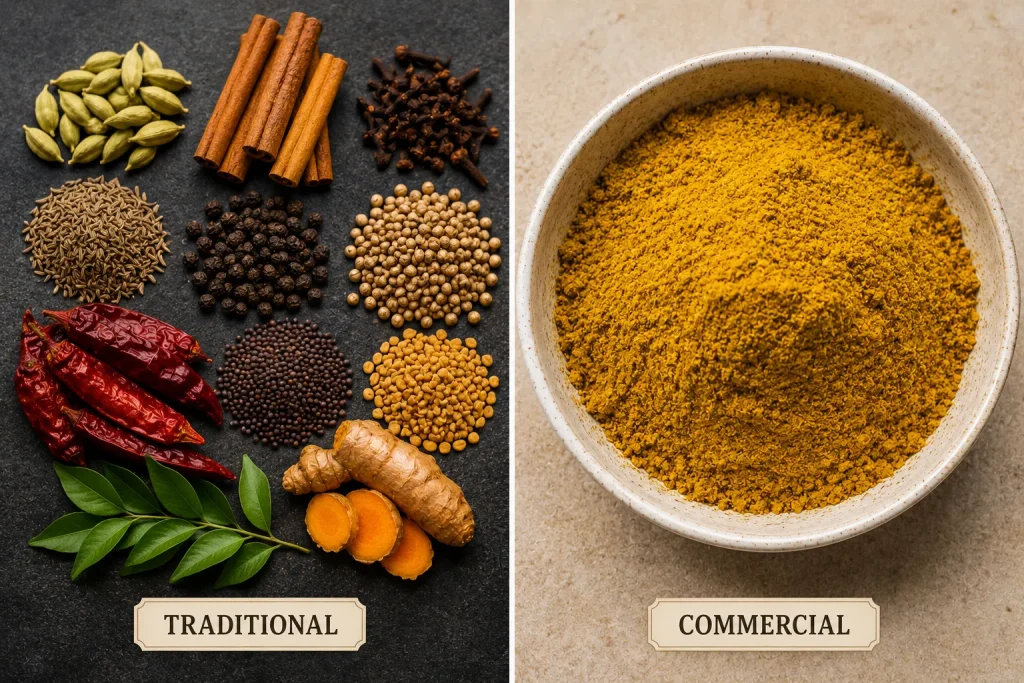
- “Curry powder” — the standardized spice blend sold in tins — is a British colonial invention with no equivalent in traditional South Asian cooking, where spice blends are specific to region, dish, and household.
- The word “curry” as used in English appears in written sources from the late 16th century, in accounts by Portuguese and British traders in South India.
- The global spread of curry as a concept was driven primarily by the British Empire: through the movement of indentured South Asian laborers to the Caribbean, East Africa, and Fiji, and through the establishment of Indian restaurants in Britain from the early 20th century onward.
Why a Word This Simple Hides a History This Complicated
Curry is one of the most ordered food categories in the United Kingdom. It is a fixture of Japanese school cafeterias, a national dish of Trinidad, a staple of South African home cooking, and the basis of one of the most consumed fast food products in Germany. The word travels everywhere. The problem is that everywhere it travels, it means something slightly different.
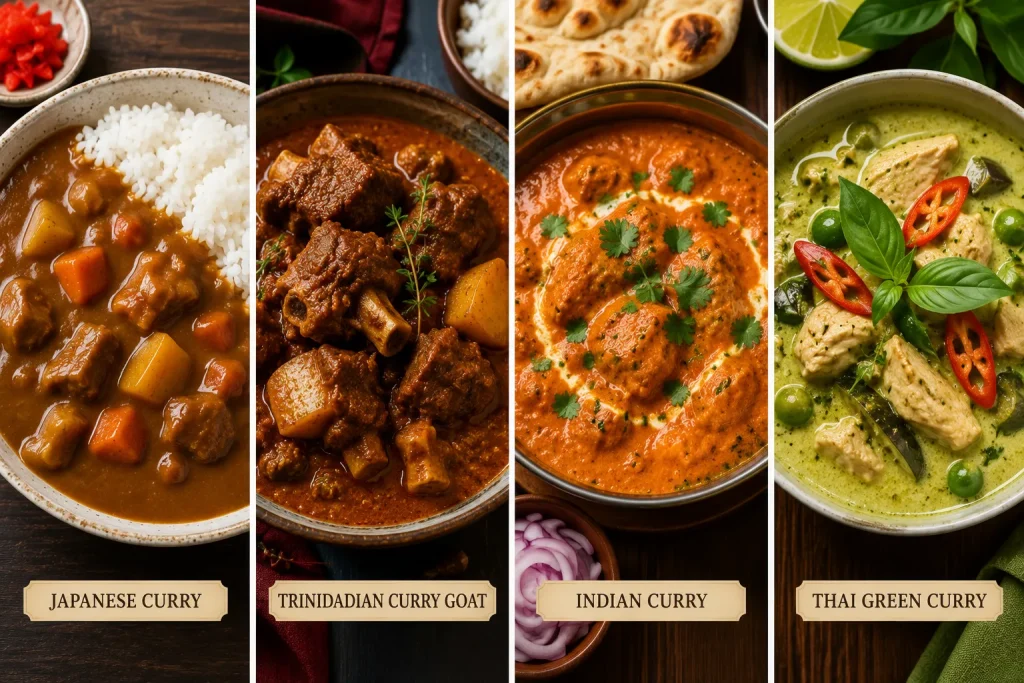
In Japan, “kare raisu” refers to a mild, sweet, thick stew served over rice, typically made from a roux-based block, and bears almost no resemblance to what is served in an Indian restaurant in London. In Trinidad, curry goat is a product of the indentured labor system that brought hundreds of thousands of South Asian workers to the Caribbean in the 19th century. In Thailand, “gaeng” — the word for what English speakers call Thai curry — predates British colonialism entirely and has its own distinct culinary logic.
Understanding the origin of curry forces a reckoning with what happens when a powerful culture imposes a single name on many different things. The name persists because it is commercially useful. The flattening it represents has costs — primarily for the culinary traditions that get reduced to a single, vaguely defined category.
The Earliest Evidence for Spiced Cooking in South Asia
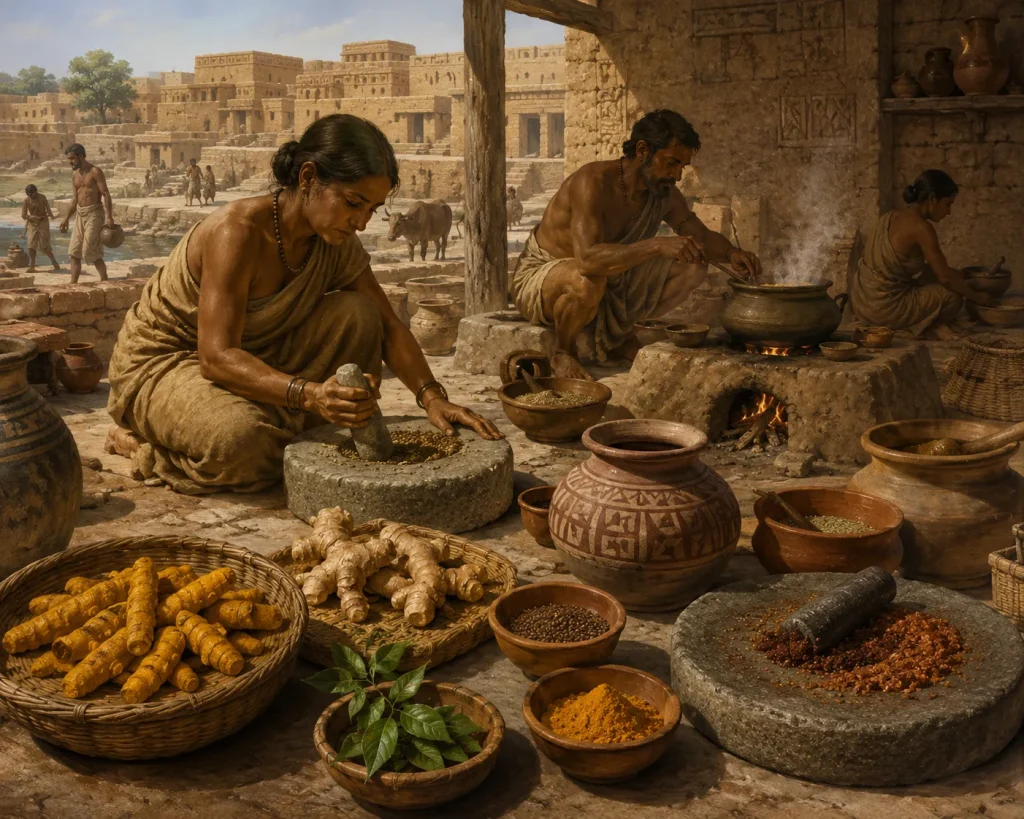
The most credible evidence for the ancient roots of what we might loosely call curry-style cooking comes not from written recipes but from archaeological chemistry.
Researchers analyzing residues on pottery shards and grinding stones from Farmana, a site in the Indus Valley Civilization dating to roughly 2500 BCE, found evidence of turmeric, ginger, and a plant related to eggplant — consistent with a spiced preparation. Similar residue analysis has found evidence of ginger and turmeric use at other Indus Valley sites. This does not prove that “curry” as a concept existed — it proves that spiced cooking using ingredients associated with modern South Asian cuisine existed in the region for a very long time.
The first written references to spiced South Asian dishes appear in Sanskrit texts and in the Arthashastra, a political treatise attributed to Kautilya and generally dated to around 300 BCE, which mentions spiced preparations in the context of food provision. These are not recipes, but they indicate that spiced sauce-based cooking was sufficiently established to be referenced in administrative writing.
The type of evidence that exists for early curry-style cooking is therefore primarily archaeological and textual-contextual rather than recipe-based. No ancient Indian cookbook survives with a dish that a modern reader would recognize as curry in the English-language sense. What survives is evidence of the underlying techniques and ingredients — which is, in itself, significant.
The word “curry” in English appears in print in a 1598 Dutch account of a voyage to India by Jan Huyghen van Linschoten, which describes a dish called “careel.” Portuguese traders in Goa in the 16th century appear to have encountered the Tamil word “kari” and carried a version of it into European languages. The word arrived in English through this colonial-commercial contact, not through any direct transmission of the dish or its tradition.
The British Construction of Curry and Why It Changed Everything
The British encounter with South Asian spiced cooking produced something that had not existed before: curry powder.
In traditional South Asian cooking, spice blends are not pre-mixed. A cook preparing a dish from Tamil Nadu uses a different combination of spices than a cook preparing a dish from Punjab, and both of those differ from what a cook in Bengal, Kerala, or Rajasthan would use. The specific blend for each dish is often made fresh, often varies by household, and is considered a form of culinary knowledge specific to place and tradition. There is no single “curry spice.”
The British, encountering this diversity and finding it commercially inconvenient, created curry powder in the 18th century as a way to approximate the flavor of South Asian cooking for consumption back in Britain and for use in colonial kitchens where trained South Asian cooks were not present. The first known commercial curry powder manufacturer in Britain dates to the late 18th century, and cookbooks of the period include curry powder recipes as a single unified blend.
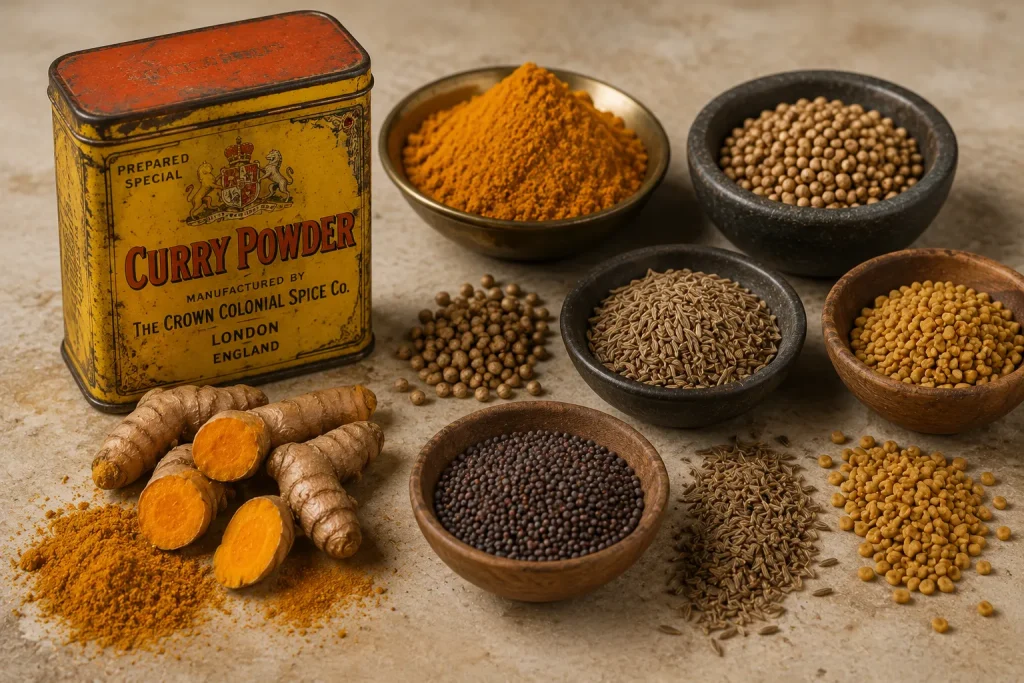
This standardization did something irreversible. It created a product that could be sold, exported, and used without any understanding of the culinary tradition it claimed to represent. By the 19th century, curry powder was being sold across the British Empire and into European markets, and the concept of “curry” as a unified, purchasable flavor was established.
The honest assessment here is that curry powder represents one of the more consequential acts of culinary reduction in food history. It collapsed hundreds of distinct spice traditions into a single commercial product, and the resulting concept of “curry” has shaped how the world understands South Asian cooking ever since — including in South Asia itself, where curry powder is now widely used.
The word also obscures a specific political reality. “Curry” as a category was useful to the British because it allowed them to describe an entire subcontinent’s cooking as a single undifferentiated thing — which made it easier to dismiss as monotonous, as primitive, or as requiring a European hand to organize and improve. This is not incidental to the history. It is the history.
How Curry Crossed Every Ocean It Encountered
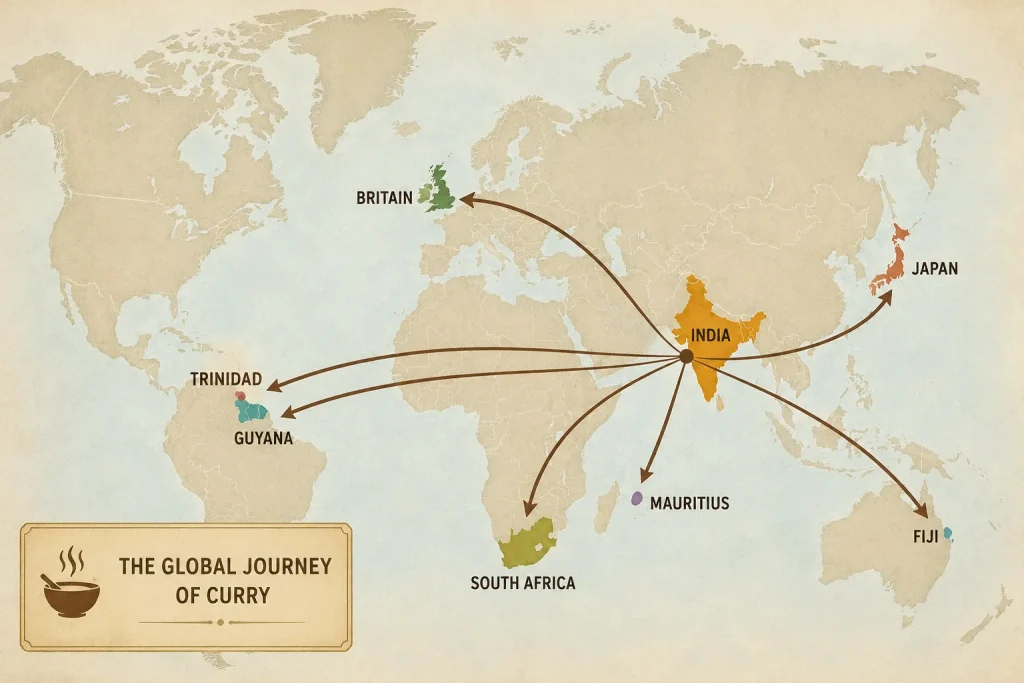
The global spread of curry followed the routes of British imperial power with striking consistency.
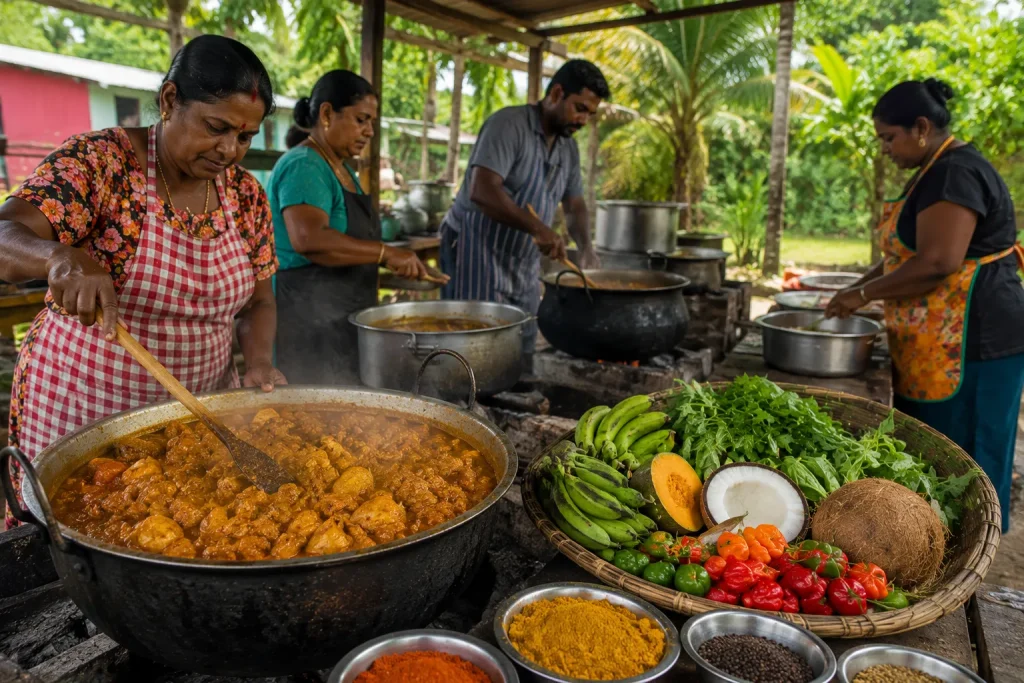
The most significant vector was the indentured labor system. After the abolition of slavery in 1834, the British Empire replaced enslaved labor across its plantation colonies with indentured workers, primarily recruited from South Asia. Between 1838 and 1917, approximately 500,000 indentured South Asian workers were transported to Trinidad and Tobago, Guyana, Fiji, Mauritius, South Africa, and East Africa. They brought with them the cooking techniques and spice traditions of their home regions, primarily from present-day Uttar Pradesh and Bihar.
In Trinidad, this produced a distinct curry tradition. Trinidadian curry goat and curry chicken are not Indian dishes — they are the product of Indian culinary technique meeting Caribbean ingredients, specifically green seasoning, scotch bonnet peppers, and local proteins, over multiple generations of adaptation. The dish exists because of forced migration. That context is rarely included in restaurant menus.
In Fiji, South Asian indentured laborers created a curry tradition that now forms a significant part of Fijian national cuisine, despite ongoing ethnic tensions between indigenous Fijians and the Indo-Fijian community.
In Britain, Indian restaurants developed primarily from the 1950s onward, staffed overwhelmingly by Bangladeshi migrants from the Sylhet region rather than from India broadly. The “Indian restaurant” in Britain is therefore largely a Bangladeshi cultural institution operating under a broader national label — another layer of the categorical compression that defines curry’s entire history. By the late 20th century, chicken tikka masala had been described by a British foreign secretary as a national British dish.
In Japan, curry arrived through the British Navy in the Meiji period, when Japan was actively modernizing along European lines. The Japanese adapted the British version of Indian curry into something distinct: thick, mild, sweet, served with rice or in bread, and manufactured industrially as a roux block. Japanese curry is now its own category, with its own regional variants, and is essentially unrelated to South Asian cooking in flavor profile.
Curry’s Global Timeline
| Period | Location | Development | Significance |
|---|---|---|---|
| c. 2500 BCE | Indus Valley (present-day Pakistan/NW India) | Archaeological evidence of turmeric and ginger use in cooking vessels | Documents ancient origins of key curry spices; not “curry” as a concept |
| c. 300 BCE | South Asia | Sanskrit texts and the Arthashastra reference spiced preparations | Establishes spiced cooking as sufficiently established to appear in formal writing |
| Late 16th century | South India / Goa | Portuguese and Dutch traders encounter Tamil “kari”; word enters European languages | Origin of the English word “curry” through colonial commercial contact |
| Late 18th century | Britain | Commercial curry powder developed and marketed | Single most consequential act of culinary reduction in curry’s history; creates the global concept |
| 1838 to 1917 | Caribbean, Fiji, East Africa, Mauritius | Indentured South Asian labor carries curry traditions across British Empire | Produces distinct regional curry traditions independent of South Asian origin |
| Mid-19th century | Japan | Meiji-era modernization brings British naval curry to Japan | Produces Japanese kare raisu — a distinct category with no direct South Asian connection |
| 1950s to 1970s | Britain | Bangladeshi migrant restaurateurs establish Indian restaurant culture | Creates the dominant Western image of curry as a restaurant experience |
| Late 20th century | Global | Industrial curry products, frozen meals, and fast food chains spread curry globally | Cements curry as a global flavor category with minimal culinary specificity |
Three Things That Are Widely Believed About Curry That Are Not Accurate
Curry is an Indian dish.
Curry is not a dish. It is a category, and it is a British colonial category at that. The foods it describes come from India, Sri Lanka, Thailand, Japan, Trinidad, South Africa, and a dozen other places. Calling curry “an Indian dish” is a bit like calling “soup” a French dish. The underlying culinary traditions are Indian in many cases, but “curry” as a unified concept is not.
Curry powder is an authentic Indian spice blend.
Curry powder does not exist in traditional South Asian cooking as a fixed product. It was invented by British food manufacturers in the 18th century to simulate South Asian flavors for the British market and colonial kitchens. The idea that a single spice blend captures “curry flavor” is a commercial fiction. A cook from Tamil Nadu, a cook from Punjab, and a cook from Kerala would not recognize each other’s spice preparations as versions of the same thing — and none of them would call what they make “curry” in their own language.
Chicken tikka masala is an Indian dish.
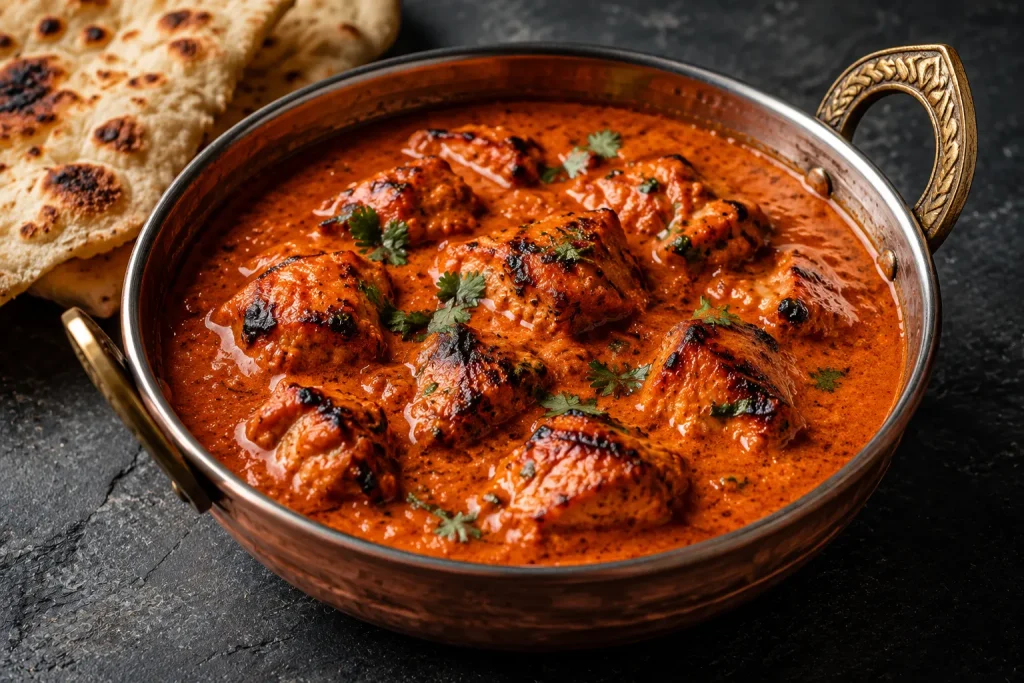
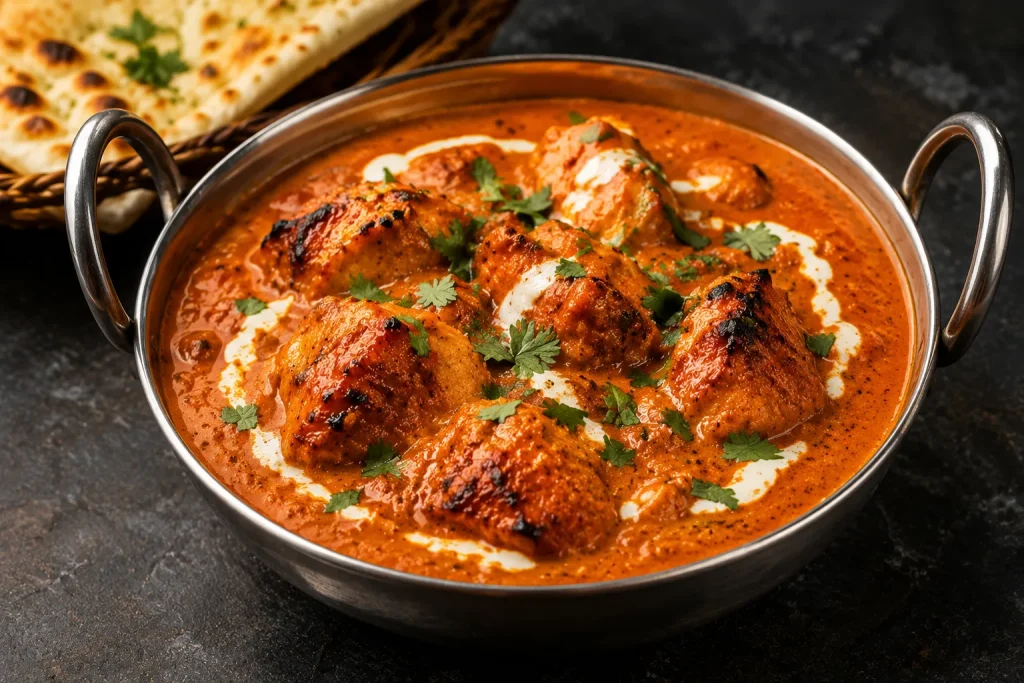
Chicken tikka masala is almost certainly a British invention, most likely developed in Britain by South Asian restaurateurs adapting to British taste preferences for saucy, mild dishes. The most frequently cited claim is that it was developed in Glasgow, though this is contested and impossible to verify with certainty. It does not appear in Indian regional cooking traditions, and while tikka itself (spiced, grilled chicken pieces) is authentically South Asian, the masala sauce that turns it into the dish most people know is a British adaptation. It is now served in Indian restaurants globally as though it were traditional, which is its own commentary on how food identity works.
What the Word “Curry” Reveals About Food, Power, and Who Gets to Name Things
The origin of curry matters today because the same dynamic that created “curry” is still active.
The reduction of diverse culinary traditions to a single marketable label is not a historical relic. It continues in the way “Asian food” is used as a restaurant category in Western markets, in the way “Mexican food” in the United States often means a narrow subset of dishes from specific regions rather than the full breadth of Mexican cooking, and in the way “African cuisine” is treated as though it describes one thing rather than dozens of distinct national and regional traditions.
For South Asian food specifically, the curry label has had commercial consequences that persist. The expectation that Indian restaurant food should be cheap — a fixture of British food culture in particular — is directly connected to the way curry was constructed as an undifferentiated mass-market product rather than a sophisticated cuisine requiring skilled preparation. Restaurant workers and owners from the Bangladeshi community, who built much of British “Indian” food culture, have been pushing back on this framing for decades.
The current conversation in food media around culinary attribution, appropriation, and representation intersects directly with the curry question. When a British food brand markets a “curry sauce” without acknowledging the traditions it draws from, or when a Western chef wins awards for “elevating” South Asian dishes that have been made with great skill for centuries, the underlying issue is the same as the one created when British merchants invented curry powder: who gets to define a food, and who profits from that definition.
The Bottom Line
The evidence most strongly supports this: there is no single origin for curry because curry as a unified dish does not exist. What exists is several thousand years of spiced cooking traditions across South Asia, and a few hundred years of British colonial taxonomy that gave those traditions a single English name and a single commercial product — curry powder — to represent them.
What remains genuinely uncertain is the precise etymology of the word itself. The Tamil “kari” origin is the most widely accepted, but it is not universally agreed upon among linguists, and the transmission path through Portuguese into English has enough gaps to leave room for legitimate debate.
The honest verdict: the origin of curry is, at its core, the story of what colonialism does to culinary knowledge. It simplifies, it standardizes, it markets, and in doing so it erases the specificity that makes a cuisine worth knowing. The foods that got labeled “curry” are extraordinary. The label itself is the problem. Every time someone orders a curry and asks where it comes from, the most accurate answer is: it depends entirely on which curry you mean.People Also Ask
Where did curry originally come from?
Spiced, sauce-based cooking of the kind associated with curry has documented roots in South Asia going back several thousand years, with archaeological evidence of turmeric and ginger use in the Indus Valley region dating to roughly 2500 BCE. However, “curry” as a word and category is a British colonial construction from the late 16th and 17th centuries, most likely derived from the Tamil word “kari.” The dish you order in a restaurant is not a single thing with a single origin — it depends entirely on which culinary tradition it comes from.
Did Britain invent curry?
Britain did not invent spiced South Asian cooking, which predates British contact by thousands of years. Britain did invent the concept of “curry” as a unified category and invented curry powder as a standardized commercial product, likely in the 18th century. These inventions had an enormous and lasting effect on how the world understands South Asian food — flattening extraordinary culinary diversity into a single label and a single purchasable blend.
What does the word “curry” actually mean?
The word most likely derives from “kari,” a Tamil word meaning a sauce or relish for rice. Portuguese and Dutch traders in South India in the 16th century appear to have encountered this word and carried a version of it into European languages, from which it entered English. The word describes something quite specific in Tamil culinary tradition — a thin, spiced sauce — but was applied by British colonizers to an enormous and diverse range of dishes that have little in common beyond the use of spices.
Is curry powder authentic?
Curry powder is not an authentic South Asian ingredient in any traditional sense. It is a British commercial invention, developed in the 18th century to approximate South Asian flavors for British consumers and colonial kitchens. In traditional South Asian cooking, spice blends are specific to the region, the dish, and often the household, and are typically made fresh rather than pre-mixed. The idea that one blend captures “curry flavor” has no basis in the culinary traditions it claims to represent.
Is chicken tikka masala really British?
Chicken tikka masala is almost certainly a British invention, most likely developed by South Asian restaurateurs in Britain adapting to local taste preferences for mild, saucy dishes. The tikka element — spiced, grilled chicken pieces — is authentically South Asian. The creamy tomato-based masala sauce is not a traditional Indian preparation and does not appear in regional Indian cookbooks prior to its emergence in British restaurants. The most commonly cited claim places its invention in Glasgow, though this is unverifiable with any confidence.
Why is curry so popular worldwide?
Curry spread globally primarily through the British Empire. The indentured labor system transported hundreds of thousands of South Asian workers to the Caribbean, East Africa, Fiji, and Mauritius between the 1830s and early 20th century, carrying cooking traditions with them. In Britain, Bangladeshi migrants established the Indian restaurant culture from the 1950s onward. Japan encountered curry through British naval influence during the Meiji period. In each location, the dish adapted to local ingredients and tastes, producing distinct regional versions with no direct connection to each other beyond a shared label.
What is the difference between Indian curry and Thai curry?
Indian curry and Thai curry share almost nothing beyond the English word applied to them. Indian curry traditions are built around dry-roasted or ground spice blends — combinations of cumin, coriander, turmeric, cardamom, and others specific to region — often with dairy, legumes, or slow-cooked meat. Thai curry is built around fresh paste made from lemongrass, galangal, kaffir lime, chili, and shrimp paste, combined with coconut milk. The flavors, techniques, and cultural contexts are entirely distinct. Both are called “curry” in English because of colonial taxonomy, not because they are related dishes.
Sources and References
Collingham, L. (2006). Curry: A Tale of Cooks and Conquerors. Oxford University Press. [The most comprehensive and rigorously researched English-language history of curry as a concept and as a colonial construction. Search via Oxford University Press or major booksellers.]
Achaya, K.T. (1994). Indian Food: A Historical Companion. Oxford University Press India. [The standard scholarly reference for the history of South Asian food, including documentation of ancient spiced cooking and spice use. Search via Oxford University Press or university library catalogues.]
Lizzie Collingham’s research on curry powder and the British Empire is the basis for several claims in the “British Construction” section. Her sourcing in the 2006 book cited above provides the primary documentation.
Archaeological residue analysis at Farmana is referenced in published work on Indus Valley foodways. For the specific residue findings, search for Chayet et al. or related archaeobotanical work on the Indus Valley Civilization in the journal Journal of Archaeological Science — the specific paper is known to the field but the exact citation should be verified against a database before publication.
Laudan, R. (2013). Cuisine and Empire: Cooking, Food, and the Making of the Modern World. University of California Press. [Provides broader historical and theoretical context for how imperial power shapes culinary categories globally, relevant to the curry-as-colonial-construction argument.]
A note on the Farmana residue analysis: this is referenced in good faith based on documented archaeobotanical research in the field. Readers intending to cite this specific claim should verify the primary source through Google Scholar or a university library before publication, as the exact paper date and authorship should be confirmed independently.