Drive two hours in most countries and the food on the table barely shifts. Drive two hours in Italy and you can go from butter-based risotto to olive-oil-soaked focaccia to a tomato sauce that would be considered wrong in the town you just left. This is not exaggeration for a travel article. Italy did not exist as a single country until 1861, and its cuisine still behaves like the collection of independent states it actually was for most of its history.
Understanding why Italian food changes so sharply over such short distances is not really a story about passionate cooks defending tradition, though there is plenty of that too. It is a story about a country unified by a flag centuries after its food culture had already hardened into place.
The Short Version of a Long Answer
- Italy was not a unified country until 1861, and before that it was a collection of independent city-states, kingdoms, and republics that each developed their own food traditions in near-total isolation from one another.
- Northern Italy’s cooler climate favored dairy cattle and rice paddies, which is why butter, cream, and risotto dominate there, while the south’s Mediterranean climate favored olive trees and durum wheat, which is why olive oil and dried pasta dominate instead.
- When Italy tried to build a “national cuisine” after unification, the most influential cookbook of the era, Pellegrino Artusi’s 1891 collection, succeeded specifically by cataloguing regional differences rather than erasing them.
- Mountain regions like Valle d’Aosta and coastal regions like Liguria developed almost opposite food cultures within the same country because one had cattle and game, and the other had fish and citrus.
- The pattern holds today because Italy’s food culture was never centralized the way its government eventually was, so hyperlocal identity, not national identity, is still what most Italian cooks are actually defending.
Why a Country the Size of Arizona Has This Many Cuisines
Italy is a relatively small country, smaller than California, yet the difference between a plate of food in Bolzano and a plate of food in Palermo can feel like crossing into an entirely different culinary world. The explanation starts with geography and finishes with politics.
The Italian peninsula stretches from the Alps to within striking distance of North Africa, covering a huge range of climate in a narrow strip of land. The north is cooler and more continental, with fertile plains suited to cattle, rice, and corn. The south is Mediterranean and dry, suited to olive trees, citrus, and durum wheat. That climate split alone accounts for a large share of the difference between a cream-based northern sauce and an olive-oil-based southern one.
Politics did the rest, and did it for far longer than geography alone would have. For most of the last two thousand years, the Italian peninsula was not one country. It was a shifting mosaic of independent city-states, republics, kingdoms, and territories controlled by foreign powers, from the Republic of Venice to the Kingdom of the Two Sicilies to territories under Spanish, French, and Austrian rule. The 19th-century national unification of 1861 spurred efforts to define a national Italian cuisine, but strong regional identities remained foundational, and this historical and political fragmentation stands as a foundational factor in shaping Italy’s remarkably diverse culinary landscape. Food traditions had centuries to calcify into place before anyone was trying to standardize them.
That same pattern, where prolonged political division hardens into permanent culinary identity, is part of why the true origin of the croissant turns out to be far more contested than the country most associated with it: food origin stories rarely respect the borders history eventually drew.
What Is Actually Different in the Ingredients Themselves
The regional divide in Italian cooking is not just about preference. It comes down to a few concrete differences in what fat, starch, and produce were locally available, and each of those has a real effect on how a dish behaves and tastes.
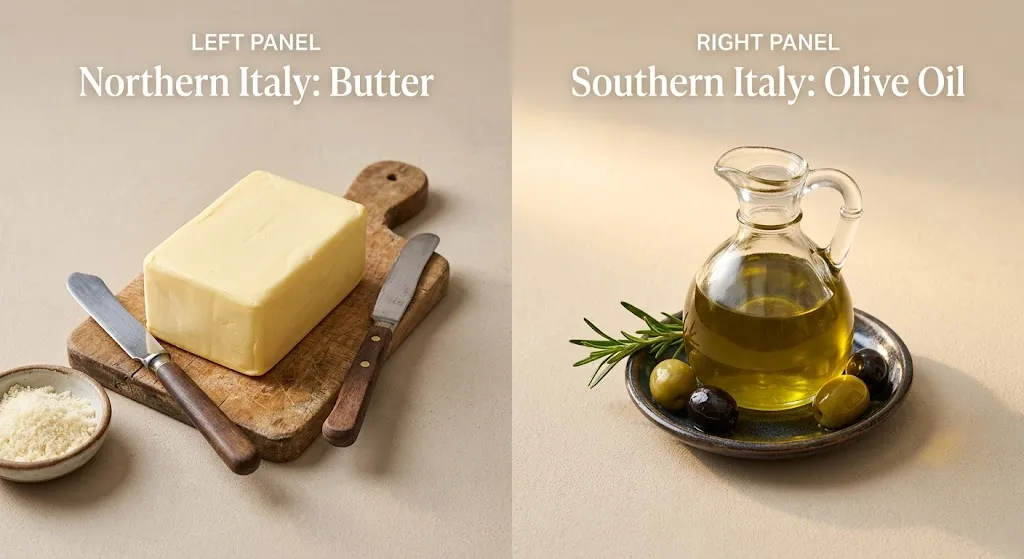
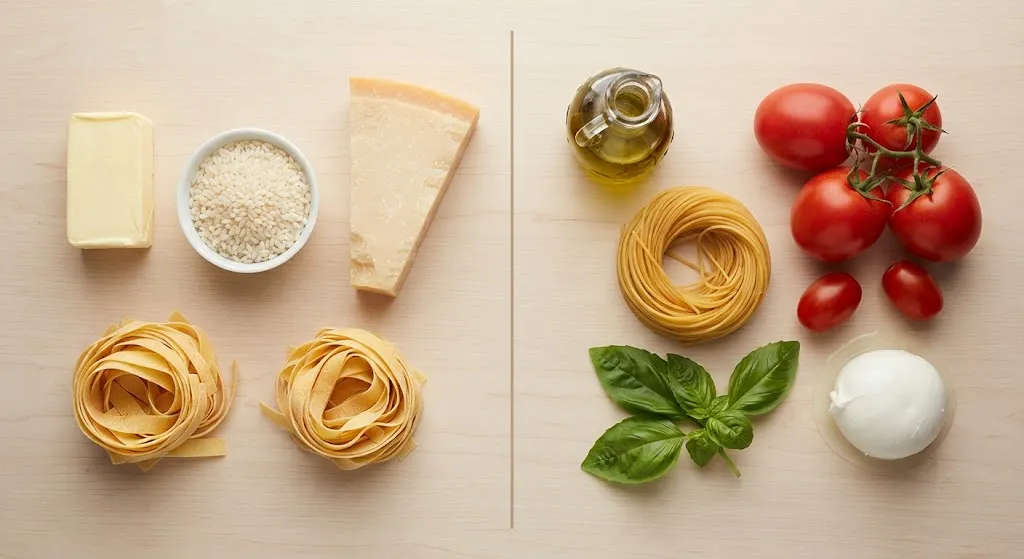
Fat is the clearest dividing line. Northern regions like Lombardy and Piedmont built their cuisine around butter and lard, a direct result of a cooler climate suited to dairy cattle. Southern regions built theirs around olive oil, since olive trees thrive in the hotter, drier Mediterranean south but struggle in the north’s colder winters. Butter and olive oil do not just taste different, they behave differently in cooking. Butter has a lower smoke point and carries dairy-derived compounds that read as rich and rounded. Olive oil carries its own fruity, sometimes peppery compounds and holds up better at the higher, faster heat that southern Italian frying and sautéing techniques rely on.
Wheat is the second dividing line. Southern Italy’s hot, dry climate is well suited to durum wheat, a hard wheat with a high gluten and protein content that is ideal for the dried pasta shapes the south is famous for. Northern Italy’s cooler, wetter climate favored soft wheat and rice instead, which is why fresh egg pasta and risotto, both built on different starches than dried durum pasta, dominate further north.
Produce follows the same logic. Coastal regions like Liguria and Campania had easy access to citrus, herbs, and seafood. Landlocked mountain regions like Valle d’Aosta relied instead on preserved meats, game, and hardy root vegetables that could survive a much harsher growing season.
The Dishes That Show the Divide Most Clearly
Risotto vs. Pasta: Two Starches, Two Climates
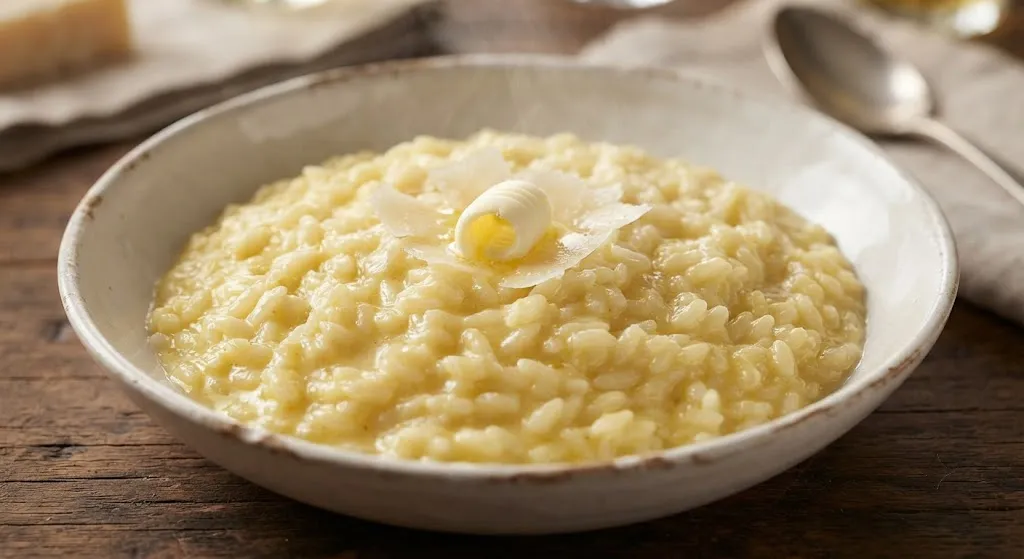
Risotto’s home is the Po Valley in the north, where the flat, well-irrigated plains made rice cultivation possible in a way it never was further south. The dish depends on a short-grain rice like Arborio, which releases starch slowly as it cooks, producing the dish’s signature creamy texture without any cream actually being added. Southern Italy’s dry climate never suited rice farming, which is one direct reason dried durum wheat pasta became the south’s staple starch instead.
Ragù alla Bolognese vs. Sugo di Pomodoro
Bologna’s ragù is built on a long-simmered combination of meat, dairy, and a small amount of tomato, reflecting the north’s cattle-rich, dairy-forward food economy. A simple southern tomato sauce, by contrast, is built around ripe tomatoes, garlic, and olive oil, cooked quickly rather than for hours, reflecting both the south’s abundance of sun-ripened tomatoes and a food culture historically built on cucina povera, or “poor kitchen” cooking that turned humble ingredients into fully realized dishes.
Neapolitan Pizza and the Ingredients It Could Not Exist Without
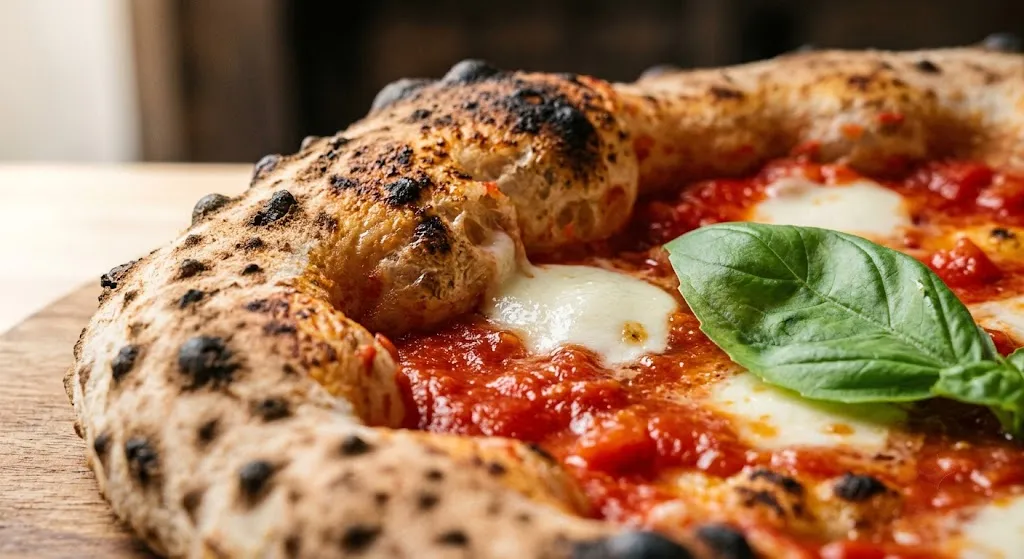
Naples’ contribution to world food history depended entirely on a specific set of local conditions: volcanic soil around Mount Vesuvius that produces particularly sweet San Marzano tomatoes, a Mediterranean climate suited to buffalo mozzarella production, and a working-class food culture that needed something fast, cheap, and shareable. The story of how that one Neapolitan flatbread eventually conquered the world is really a story about a hyperlocal dish surviving contact with the entire planet without losing its regional DNA.
Valle d’Aosta: What Italian Food Looks Like Without the Mediterranean
In the mountains bordering France and Switzerland, Italian food stops looking Mediterranean almost entirely. Valle d’Aosta’s cuisine relies on hearty mountain cheeses, cured meats, game, and root vegetables suited to a much colder climate and shorter growing season than the rest of the country, proof that “Italian food” was never one climate’s cuisine wearing different regional hats.
Northern Italy vs. Southern Italy at a Glance
| Category | Northern Italy | Southern Italy |
|---|---|---|
| Primary fat | Butter, lard | Olive oil |
| Primary starch | Fresh egg pasta, rice (risotto) | Dried durum wheat pasta |
| Climate | Cooler, continental, fertile plains | Hot, dry, Mediterranean |
| Signature dish | Risotto alla Milanese, ragù alla Bolognese | Neapolitan pizza, simple tomato-based sauces |
| Historical food philosophy | Dairy and cattle-based abundance | Cucina povera, olive oil and produce-based simplicity |
How This Compares to Other Countries With Fractured Culinary Histories
Italy is not alone in having its cuisine shaped more by historical fragmentation than by modern borders. The same underlying pattern, a large landmass with sharp climate variation producing distinct regional food cultures almost automatically, is part of how China ended up with the world’s most geographically diverse single national cuisine, even though China unified as a political entity far earlier than Italy did.
The difference is that Italy’s fragmentation was recent enough, and the country small enough, that regional food identity never had to compete with a long-standing national one. Pellegrino Artusi’s 1891 cookbook attempted to create a national cuisine precisely when political unification threatened regional distinctions, and rather than imposing a single standard, it catalogued regional diversity itself as Italian identity, which is arguably why Italy is one of the only major food cultures where “regional” was allowed to remain the default setting instead of the exception.
What This Means Next Time You Order Italian Food
If a menu simply says “Italian,” that is usually the first sign the dish has been flattened into an export version rather than a specific regional one. A menu that names Bologna, Naples, or Liguria directly is a much stronger signal you are getting something closer to the original.
One useful habit: pay attention to the fat. If a sauce is built on butter and cream, you are almost certainly looking at a northern dish. If it leans on olive oil and tomato, you are looking at something with southern roots. That single detail tells you more about a dish’s actual origin than the word “Italian” ever will, in the same way that understanding a single defining ingredient reshapes how you read why French cooking developed such a distinctly rich, layered flavor profile around fat rather than around acid or spice.
It is also worth remembering how much history is baked into ingredients that now feel completely ordinary. Olive oil, citrus, and durum wheat were not always cheap or widely available, and their spread across trade routes is part of the same larger story that explains why a spice like pepper was once worth more than gold: what a region could grow, buy, or trade for shaped its food far more than taste preference ever did.
The Exceptions That Complicate the North-South Story
The north-south divide is the dominant pattern, but it is not the whole story. Liguria, technically part of the north, cooks far closer to a Mediterranean, olive-oil-forward style than its northern neighbors, since its coastal, hilly terrain never suited dairy cattle the way the Po Valley did.
Sicily complicates the picture from the other direction. Centuries of Arab rule left the island with a food culture built around sweet-and-sour flavor combinations and elaborate desserts like cannoli, a profile distinct from the rest of southern Italy despite sharing its climate and geography. Sardinia, similarly, developed its own food identity in relative isolation from both the mainland north and south, shaped more by its own history of foreign rule than by the peninsula’s broader north-south split.
The Bottom Line
Italian food did not become this regionally fractured by accident, and it has not stayed this way out of stubbornness either. Climate decided what grew where, centuries of political division let each region’s food culture harden into place long before a single Italian government existed, and by the time unification arrived, the most successful response was to catalogue the differences rather than erase them. The next time you cross from a butter-rich northern dish to an olive-oil-soaked southern one in the same meal, what you are actually tasting is a country that spent most of its history as several different ones.
People Also Ask
Why is northern Italian food so different from southern Italian food?
The north’s cooler, continental climate favored dairy cattle and rice farming, leading to butter- and cream-based dishes like risotto. The south’s hot, dry Mediterranean climate favored olive trees and durum wheat, leading to olive-oil-based sauces and dried pasta instead.
Is there such a thing as one authentic Italian cuisine?
Not really. Italy was not a unified country until 1861, and its regions developed food traditions independently for centuries before that. Most food historians treat Italian cuisine as a collection of regional cuisines rather than a single national one.
Why does Italy have so many regional pasta shapes and sauces?
Local wheat types, climate, and centuries of political fragmentation meant each region developed pasta shapes and sauces suited to its own ingredients and cooking traditions, with very little standardization until relatively recently.
Did Italian unification create a single national cuisine?
No. Unification in 1861 sparked efforts to define a national cuisine, but the most influential attempt, Pellegrino Artusi’s 1891 cookbook, succeeded by cataloguing regional differences rather than replacing them, and that regional emphasis has remained the norm since.
What is cucina povera and how does it relate to regional Italian food?
Cucina povera, meaning “poor kitchen,” refers to a style of cooking that emerged from economic necessity in regions like Puglia, turning humble, inexpensive ingredients into fully developed dishes. It remains a strong influence on southern Italian cooking’s emphasis on simplicity.