
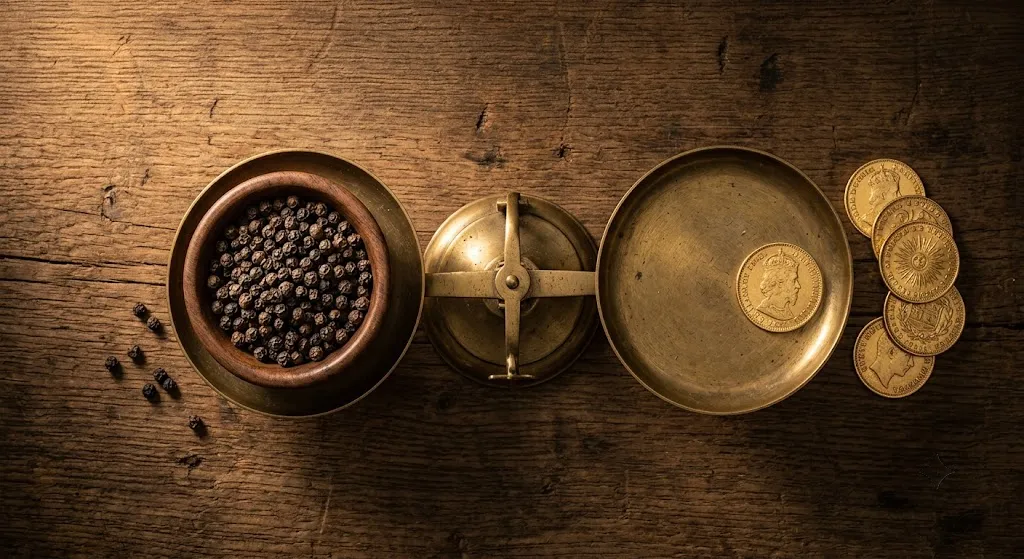
The claim shows up in almost every food history roundup and every spice tin’s back label: pepper was once worth its weight in gold. It is repeated so often that it reads as settled fact. The actual price records historians have recovered do not support a literal weight for weight trade between peppercorns and gold at any point that can be documented. What the records do show is stranger and more specific than the myth, and it explains why the exaggeration stuck.
The Claim, the Evidence, the Actual Answer
- Pliny the Elder recorded black pepper at roughly four denarii per Roman pound around 77 CE, expensive but nowhere near the price of an equivalent weight of gold coin at the time
- Pepper was demanded as part of the ransom the Visigoths took from Rome in 408 CE, alongside separate quantities of gold and silver, which tells you it was treated as its own category of wealth, not gold’s equal
- English King Ethelred II required German traders to pay a toll of pepper before doing business in London around the turn of the 11th century, one of the clearest examples of pepper functioning as currency
- The phrase “peppercorn rent,” still used in property law today to describe a token payment, exists because pepper was once valuable enough to be accepted as real payment
- No surviving price record from antiquity or the medieval period shows pepper trading at true gold parity by weight
Why the Myth Was Useful to the People Who Told It
Pepper’s reputation as a substance nearly as precious as gold did not appear by accident. Arab traders controlled the overland and maritime routes carrying pepper out of India for centuries, and controlling the story around a commodity was as valuable as controlling its supply, a dynamic Britannica’s overview of the pepper trade traces through the shifting powers that ran the Middle Eastern trade corridors.
Medieval European writers preserved a tale claiming pepper grew in Indian forests guarded by venomous serpents, and that traders had to burn the trees to drive the snakes off, which is what supposedly turned the peppercorns black. Today I Found Out’s history of the spice documents how this myth traces back to a mistranslation of the Roman writer Isidore, later repeated as fact for centuries.
A commodity guarded by snakes and requiring a burned forest to harvest sounds like it should cost as much as gold. That is precisely the impression the story was built to create, whether or not the actual invoices agreed.
Genoa and Venice later took over that same instinct. The International Pepper Community’s account of the trade’s history notes that these two cities built their medieval prosperity almost entirely on pepper brokering, marking up a spice they did not grow with the same confidence the Arab traders once had.
The most credible evidence for black pepper’s origin points to the Malabar coast of what is now Kerala, India, where the pepper vine, Piper nigrum, grows natively. According to Wikipedia’s entry on black pepper, the spice was known in Greece by the 4th century BCE and had become an integral part of the Roman diet by around 30 BCE.
What the Earliest Records Actually Show
Archaeological evidence pushes the use of pepper back even further. Peppercorns have reportedly been found packed into the nostrils of Ramses the Great during mummification in the 13th century BCE, which suggests trade contact between India and Egypt long before any Roman ship made the journey.
By the early Roman Empire, the trade had become organized and substantial. The World History Encyclopedia’s account of pepper’s route from East to West describes how Roman fleets timed their voyages to the Malabar coast around the monsoon winds, sailing out in one season and returning laden with pepper, cinnamon, and incense in the next.
This is where the anti hallucination caveat matters. The earliest written descriptions of the pepper trade come largely from Greek and Roman sources, not Indian ones, simply because those are the documents that survived and were catalogued by later European scholars. Indian cultivation and use of pepper almost certainly predates any Mediterranean account of it by a wide margin. The written record is a record of European contact with pepper, not the birth of pepper itself, a distinction that shapes how the broader spice trade’s path across Asia is documented more generally.
The Investigation: Did Pepper Ever Actually Equal Gold in Price
The strongest version of the myth points to Pliny’s own writing, since he directly recorded Roman market prices and complained bitterly about pepper’s cost. The Antecedent’s detailed breakdown of Roman pepper prices calculates that at four denarii per pound against an annual military wage of roughly 225 denarii, a single pound of pepper cost close to two days of a soldier’s pay. That is a genuinely expensive spice. It is not gold.
A Roman pound of gold, minted into coin, was worth vastly more than a few days of a soldier’s pay. There is no surviving Roman price list that puts pepper anywhere near gold’s value per unit of weight. Pliny complained about the Roman obsession with pepper, calling it a needless frivolity that squandered wealth on something with no nutritional necessity behind it, but frivolous spending and gold parity are not the same claim, and later retellings have quietly merged the two.
The evidence against the literal version gets stronger the closer you look at how pepper actually moved through medieval trade networks. It changed hands repeatedly, from Malabar coast growers to Arab middlemen to Alexandrian brokers to Venetian importers to European retailers, and each transfer added a markup. Venetian merchants alone raised prices by more than 40 percent during the 15th century, a markup pattern EBSCO’s research summary on the pepper trade ties directly to the rise of centralized trading bureaucracies built specifically to regulate and protect the commodity. What you were paying for in Bruges or London was not the pepper itself so much as the accumulated cost of every hand it had passed through to get there.
Where the myth earns some credibility is in how pepper functioned rather than what it cost. It genuinely worked as a substitute for hard currency. Rents, dowries, and taxes were paid in it. The 408 CE ransom of Rome by Alaric’s Visigoths included gold, silver, silk robes, and 3,000 pounds of pepper as separate, itemized categories of loot, which only makes sense if pepper was considered valuable enough to be demanded in its own right, alongside precious metal rather than instead of it.
The honest verdict sits in the middle. Pepper was never documented trading pound for pound with gold at any specific market price historians have recovered. It was, for close to two thousand years, one of the small number of commodities valuable enough, portable enough, and internationally recognized enough to be treated like currency. The saying survived because it captures something true about pepper’s status even though it gets the math wrong.
Before You Read This, You Probably Thought Pepper Literally Traded for Gold
If you came in assuming pepper once sold for the same price as an equivalent weight of gold, that is not an unreasonable thing to believe. It is the version of the story that gets repeated on spice packaging, in trivia lists, and in a huge number of articles about pepper’s history, usually without a single price record attached to back it up.
The actual historical documents tell a slightly less dramatic but arguably more interesting story. Pepper did not need to equal gold’s price to reshape trade routes, fund the rise of Venice and Genoa, and help motivate the voyages of Vasco da Gama and Christopher Columbus. It only needed to be valuable enough, and rare enough outside its native growing region, for entire empires to organize their commerce around getting more of it, the same forces that eventually carried spice-driven trade routes into the layered flavor profiles Indian cooking is known for today.
The Claim Against the Record
| The Claim | Appears In | Evidence For | Evidence Against | Verdict |
|---|---|---|---|---|
| Pepper traded at true gold parity by weight | Spice tins, trivia lists, food blogs | Pliny records it as genuinely expensive; pepper functioned as currency | No surviving Roman or medieval price record shows pepper matching gold’s per pound value | Not supported as a literal price claim |
| Pepper was accepted as a form of payment | Legal terminology, medieval tax records | “Peppercorn rent” survives in property law; King Ethelred II collected pepper as a toll | Used alongside coin currency rather than replacing it entirely | Well documented |
| Pepper alone caused the Age of Exploration | Popular history summaries | Da Gama and Columbus were both explicitly seeking spice routes | The broader spice trade, including cinnamon and cloves, and the search for a route around Ottoman and Arab middlemen were equally significant drivers | Partly true, but pepper was one motive among several |
| Pepper was cultivated in snake-guarded forests | Medieval European travel accounts | Recorded by multiple Roman and medieval writers as fact at the time | Traced by modern historians to a mistranslated and later fabricated myth protecting an Arab monopoly | Fabricated, but historically significant as propaganda |
What This History Does to a Jar of Ground Pepper on Your Counter
Knowing that pepper never literally cost as much as gold does not make its history less remarkable. It makes it more specific. What actually happened is that ordinary market forces, distance, monopoly control, and repeated markups, turned a common Indian spice into one of the most consequential trade goods in premodern history, without any single transaction ever pricing it against bullion.
The next time you reach for a pepper grinder, you are holding the same plant that helped fund the rise of Venice, that European monarchs collected as tax, and that sent ships around the coast of Africa looking for a shorter route to its source. It never needed to be gold. It only needed to be pepper, at the right price, in the wrong hands’ monopoly, for long enough to change how the world traded with itself. That trade history sits behind the layered heat found in dishes like the biryani traditions built on the same Malabar coast spice routes, and it still shows up today in rankings of the world’s most intensely flavored cuisines.
The Bottom Line
The evidence most strongly supports pepper as an extraordinarily valuable trade commodity that functioned as a form of currency for centuries, without ever being formally priced at parity with gold. What remains genuinely uncertain is exactly how the “worth its weight in gold” phrasing first attached itself to pepper, since no single origin point for the saying survives in the historical record.
TasteHavenDaily’s read on this is that the myth persists because it is a cleaner story than the real one. The real one requires understanding monopolies, markup chains, and monarchs collecting spice as tax, which takes longer to explain than a single tidy comparison to gold. Grind some onto your plate tonight and you are seasoning your food with the same plant that once got itemized in a ransom payment next to gold and silk.
People Also Ask
Was pepper really worth its weight in gold?
No surviving price record shows pepper trading at literal gold parity by weight. Roman writer Pliny the Elder recorded pepper at four denarii per pound, expensive relative to wages but far below gold’s value. The phrase captures pepper’s extraordinary status rather than an accurate price comparison.
Where does black pepper originally come from?
Black pepper is native to the Malabar coast of present day Kerala, India. Archaeological and classical trade records place its cultivation and export from that region for well over two thousand years before it became widespread in Europe.
Why was pepper so expensive in medieval Europe?
Pepper passed through several middlemen before reaching European buyers, from Indian growers to Arab traders to Alexandrian brokers to Venetian and Genoese merchants, and each stage added a markup. Distance, monopoly control, and deliberate myth making around its scarcity all pushed the retail price higher.
Did pepper actually cause the Age of Exploration?
Pepper was one of several motivations, not the sole cause. Vasco da Gama and Christopher Columbus were both explicitly searching for direct routes to spice producing regions, but cinnamon, cloves, and the broader goal of bypassing Ottoman and Arab middlemen were part of the same push.
What is peppercorn rent and why does it still exist as a term?
Peppercorn rent refers to a token payment, today usually a nominal or symbolic amount specified in a lease. The term survives from a time when pepper was valuable enough to be accepted as genuine payment for rent, taxes, and even dowries.
Is the story about pepper growing in snake guarded forests true?
No. The tale traces back to a mistranslation of a Roman writer’s description of pepper trees, later embellished into a full myth that protected an Arab trading monopoly by making the spice sound dangerous to obtain.
When did pepper stop being a luxury item?
Pepper’s price fell sharply as European trading companies established direct sea routes and expanded cultivation to new regions in the 17th and 18th centuries. By the 1800s it had become affordable enough for common households, ending its centuries long run as a symbol of wealth.
Sources and References
Turner, J. (2004). Spice: The History of a Temptation. Vintage Books.
Collingham, L. (2005). Curry: A Tale of Cooks and Conquerors. Oxford University Press.