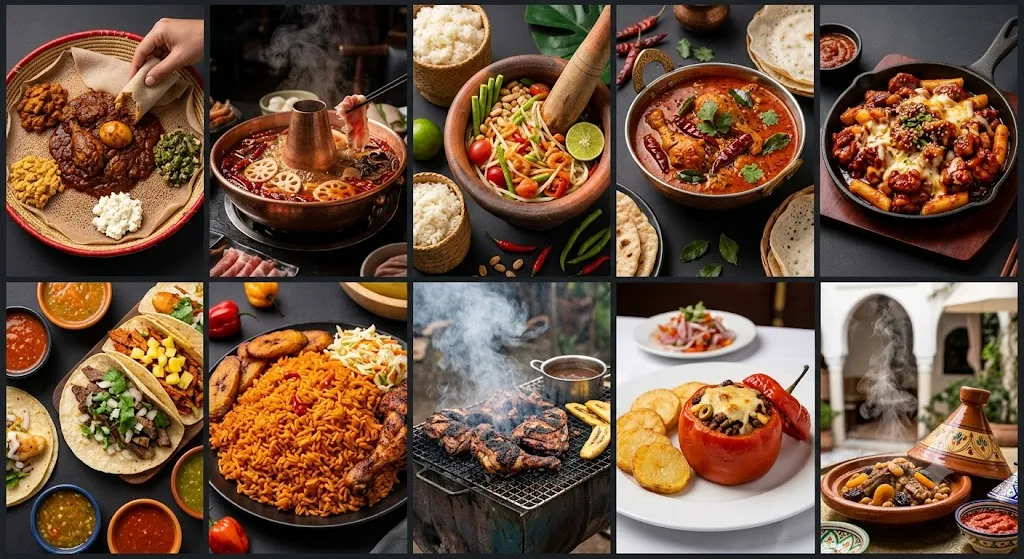
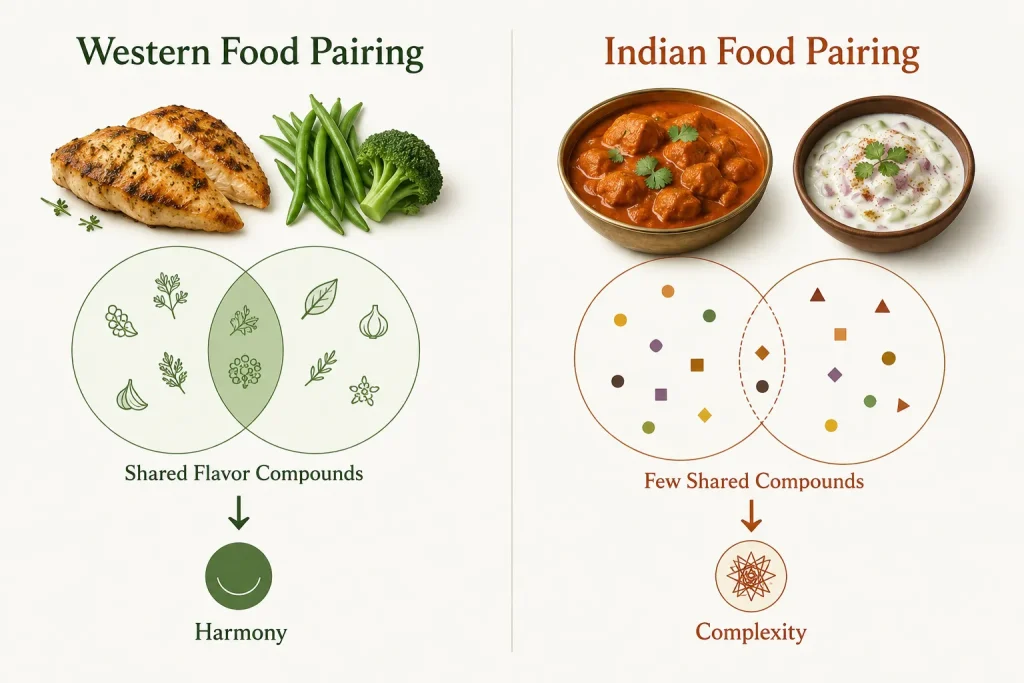
Indian cuisine does not build flavor the way almost every other cuisine on earth does. Most food cultures combine ingredients that share flavor compounds, the idea being that similar things harmonize. Indian cooking does the opposite – deliberately and systematically. Research has confirmed that Indian food’s defining characteristic is that its components have very little in common, a phenomenon called negative food pairing, where ingredients barely share flavor compounds at all. The result is a kind of controlled flavor tension that your brain finds impossible to tune out.
That tension is not accidental. It took geography, trade history, a sophisticated understanding of how heat and fat work on aromatic molecules, and thousands of years of cooking to get there.
What Is Actually Happening on Your Tongue
Indian food tastes complex because it is chemically complex — and by design, not coincidence. Here is the short version:
- Researchers at the Indian Institute of Technology found that, unlike Western cuisine where recipe ingredients share flavor compounds, Indian ingredients typically do not share these qualities at all — a pattern called negative food pairing.
- Most key flavor compounds in Indian spices are fat-soluble, not water-soluble, which means they can only be unlocked by cooking in oil or ghee — not by simmering in water.
- Spices are added at multiple stages of cooking, so early spices build a flavor base while later ones stay sharp and distinct on top.
- Capsaicin — the compound in chili peppers — does not register as a taste at all. It binds to pain receptors, and the body responds with a flood of endorphins, which is why heat feels good once you are used to it.
- The result is a dish where no single flavor dominates because none of the ingredients are pulling in the same direction. Every bite is your brain attempting to process multiple unrelated signals simultaneously.
Why India’s Geography Made Spice-Forward Cooking Inevitable
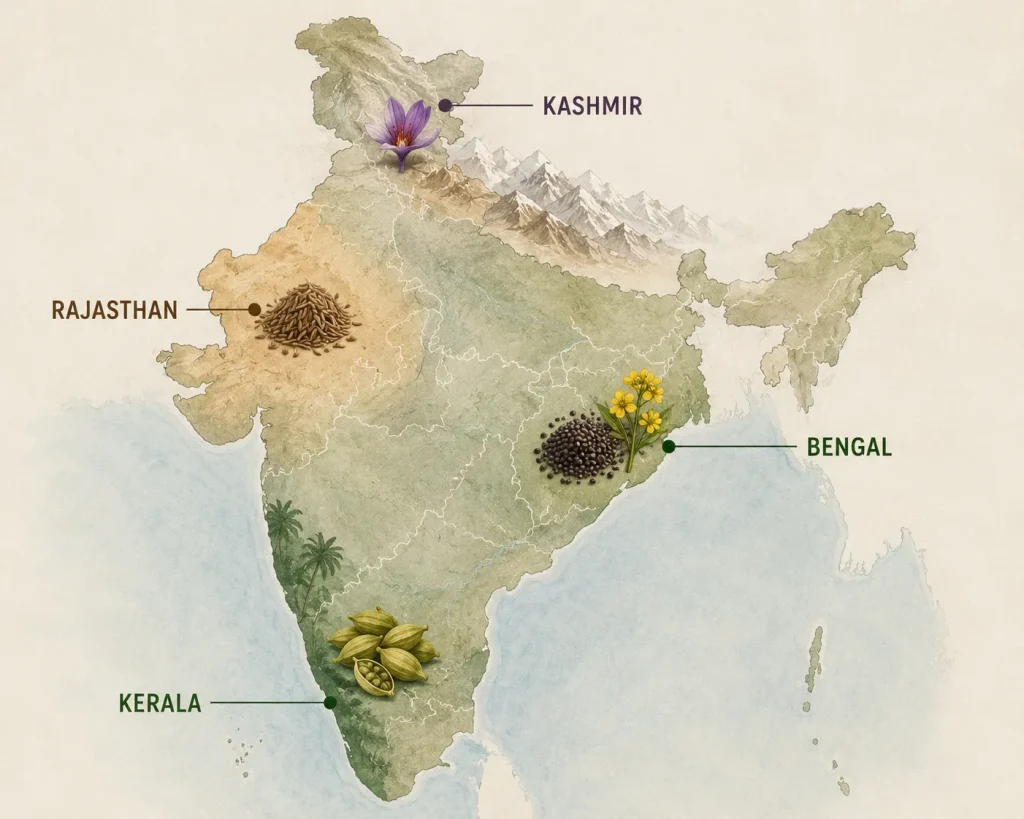
India sits in one of the most biodiverse regions on earth for edible plants. The subcontinent’s range of climates — tropical coastlines, arid plains, Himalayan highlands, monsoon forests — means it can grow spices that no single European or East Asian region could. Cardamom grows in Kerala’s wet hills. Cumin thrives in Rajasthan’s dry heat. Mustard seeds dominate Bengal’s river delta. Saffron comes from Kashmir’s cool altitude. This was not just convenient. It made India the supplier for the entire ancient spice trade.
The economic consequence was enormous. Spices were once more valuable than gold, and traders from across the world introduced new spices and cooking styles that made Indian food progressively more diverse and layered. Arab, Persian, Portuguese, Mughal, and British trade all deposited ingredients and techniques that became permanent features of the cuisine — a process explored in depth in the surprising journey of curry across the world. Chili peppers — now considered quintessentially Indian — only arrived with the Portuguese in the 16th century. Before that, heat in Indian food came from black pepper and ginger.
The other geographic factor that shaped Indian flavor is heat itself. In warm climates, food spoils faster. One of the strongest rationales for the use of spices in Indian cooking is the antimicrobial hypothesis — spices are used partly because of their activity against food spoilage bacteria, and many also serve as antioxidant and anti-inflammatory agents. In other words, the spice combinations that taste most complex also happen to be the ones that kept food safe longest. Flavor and function evolved together.
The Chemistry Behind Why Indian Food Tastes Different From Everything Else
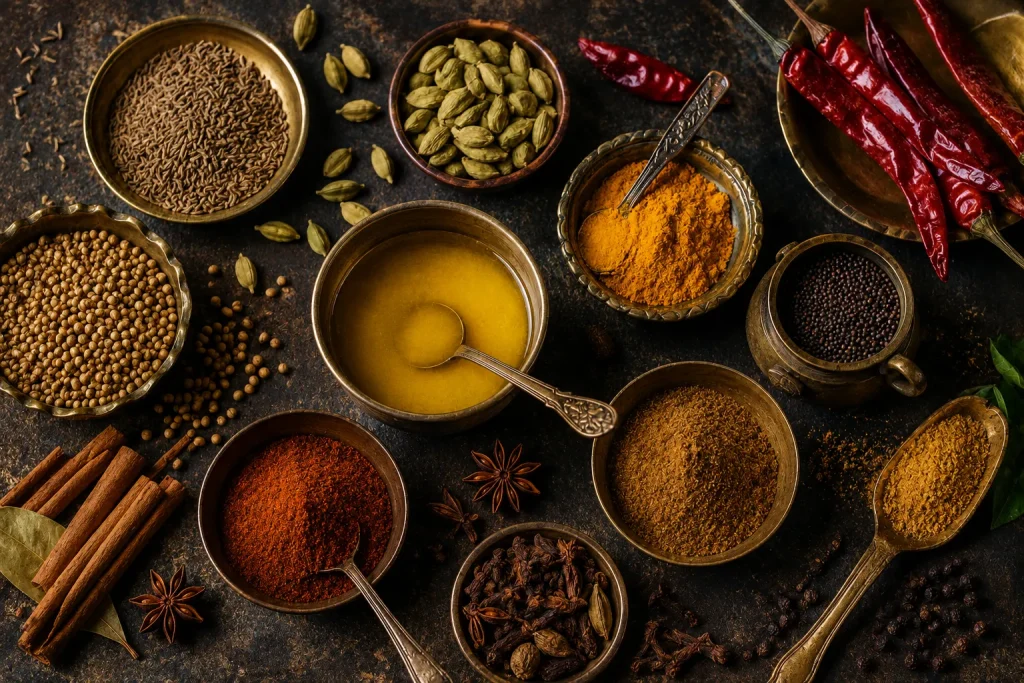
The first thing to understand is what spices actually are, chemically. Most Indian spices contain essential oils made up of volatile compounds — organic compounds that vaporize at room temperature and are a major force behind a food’s flavor and aroma. For most spices, these aromatic compounds are locked inside a tough plant cell wall.
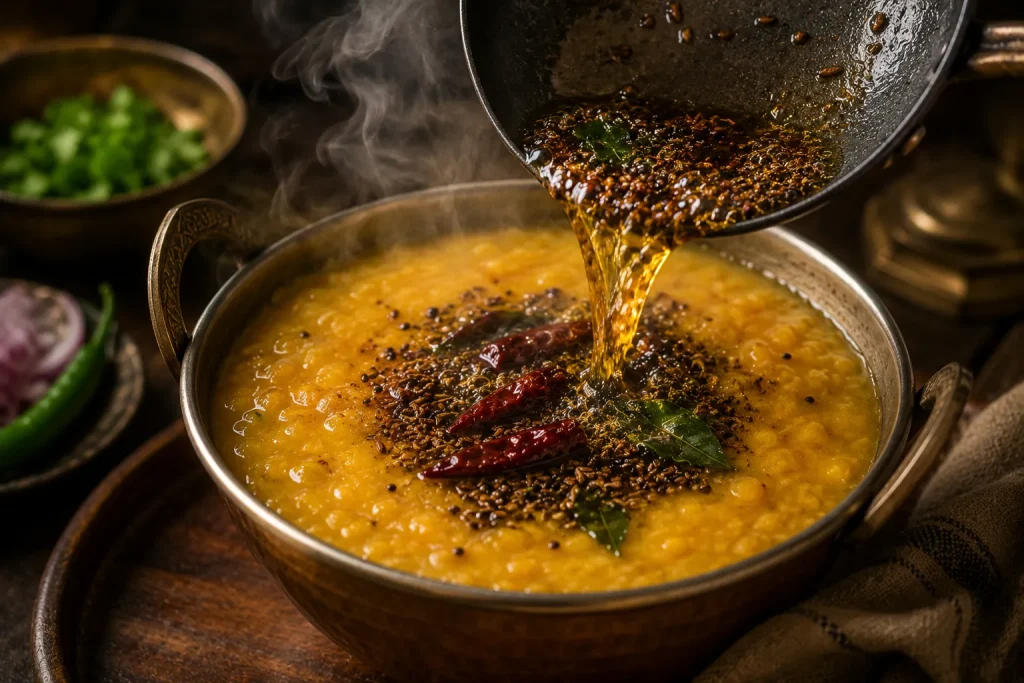
Getting them out requires heat and fat. When spices hit hot fat at around 180 to 200°C, fat acts as a solvent, extracting fat-soluble compounds like terpenes, phenols, and essential oils that water simply cannot touch. This is the science behind tadka — the technique of blooming spices in hot oil or ghee that opens almost every Indian dish. The cell wall ruptures, releasing the volatile compounds, and the high temperature triggers a Maillard reaction — a chemical process where heat transforms proteins and sugars into hundreds of new aromatic molecules — deepening the spices’ flavors and aromas further.
Now add the negative pairing principle on top of this. The presence of certain spices makes the negative food pairing effect even stronger — cayenne, green bell pepper, coriander, garam masala, tamarind, ginger, and cinnamon each push the cuisine further away from flavor-sharing, not toward it. So you are not just getting complex extraction chemistry. You are getting complex extraction of chemically unrelated molecules, all at once, all competing for your attention. Your taste and smell receptors are essentially being asked to process a dozen separate conversations simultaneously. That is the sensation people describe as “complex” or “layered” — it is not metaphor, it is neuroscience.
The chili heat adds another dimension entirely. Capsaicin — the active compound in hot peppers — does not stimulate your taste buds the way salt or sugar do. Capsaicin activates the TRPV1 receptor, a heat-sensing pain channel that normally fires when tissue temperature exceeds 43°C (109°F). The brain interprets capsaicin as burning heat even when no actual heat is present. Activation of these TRPV1 receptors leads to an influx of calcium ions, which results in increased intracellular signaling and the release of endorphins — the same compounds released during exercise or laughter. This is why people become genuinely addicted to spicy food. The pain is real but the pleasure response is also real, and with repeated exposure the threshold for both shifts upward. If you want to see how this heat compares across cultures, the world’s spiciest cuisines ranked puts Indian food in its global context.
Piperine, the active compound in black pepper, works differently — it inhibits enzymes that would otherwise break down other flavor compounds in the dish, effectively making everything else taste stronger and last longer on the palate.
The Techniques and Ingredients That Carry Indian Flavor
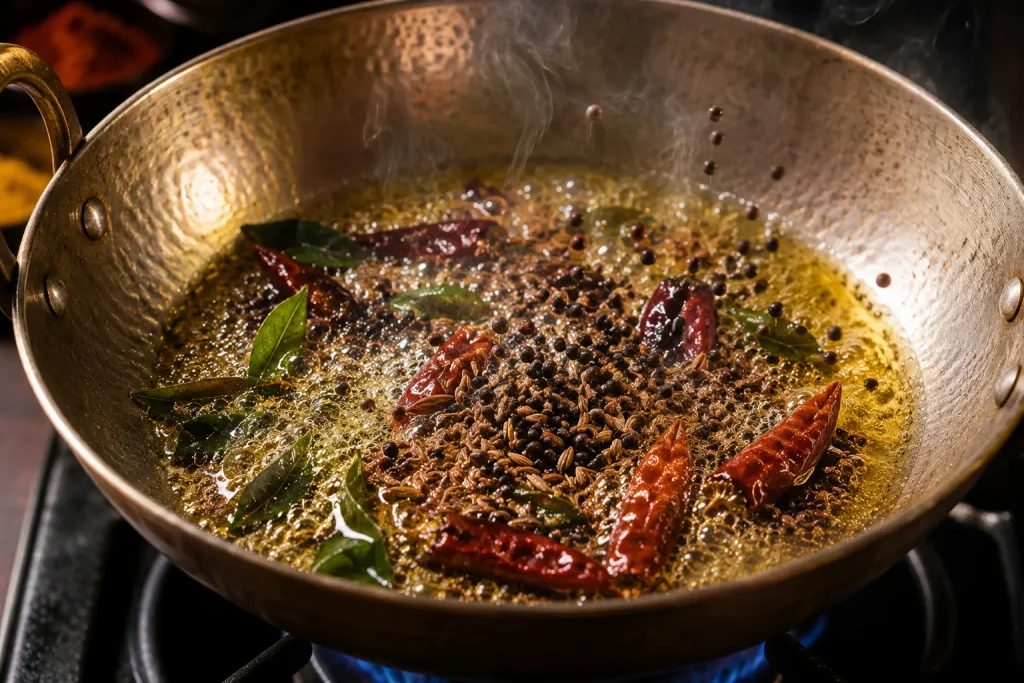
Tadka: The Most Important 30 Seconds in Indian Cooking
Tadka — also called tempering, chhonk, or baghaar depending on the region — is the act of blooming whole spices in hot fat before building the rest of a dish. It is not just a tradition in Indian cooking; it is a controlled chemical reaction designed to extract, dissolve, and transform the flavor molecules in spices. The dish genuinely cannot taste right without it. Raw mustard seeds taste bitter. Tempered, they provide a distinctive sharpness. Raw fenugreek is bitter. Tempering develops a maple-like, complex sweetness. Asafoetida — the famously pungent resin called hing — requires tempering in oil to transform from unpleasant-smelling to savory and umami-rich. The ingredients going into the pan are not the same substances that come out of it. Tadka is transformation, not flavoring.
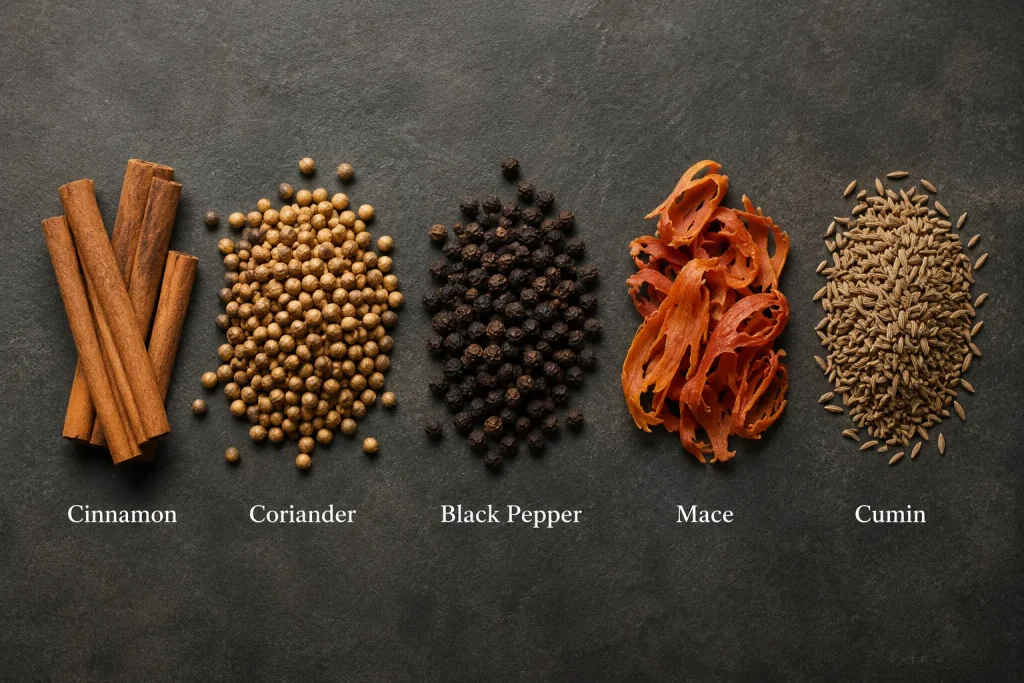
Garam Masala: A Blend That Defies the Flavor-Pairing Logic
Garam masala is the most misunderstood ingredient in Indian cooking. Outside India it is treated like a single spice. It is actually a system. The exact blend varies by region, by family, and by the dish it is going into. A typical garam masala combines cinnamon, mace, peppercorns, coriander seeds, and cumin — where cinnamon adds warmth, mace brings sweetness, and coriander contributes earthiness. None of these share significant flavor compounds. The blend does not aim for harmony between similar things — it aims for harmony between very different things, which is exactly the negative pairing principle applied at the blend level. Garam masala is usually added near the end of cooking to preserve its aromatic brightness rather than letting it dissolve into the base.
The Maillard Foundation: Onions, Garlic, and Ginger
Before the spices arrive, most Indian dishes build a flavor base from long-cooked onions, garlic, and ginger. When spices are heated, cell walls break down, essential oils get released, and aromatic molecules become more volatile — heat pumps up aroma, which is why the kitchen fills with fragrance within seconds of spices hitting hot oil. But the onion-garlic-ginger base does something different. Cooked low and slow, onions go through the Maillard reaction — the same browning chemistry that happens to bread crusts and seared meat — producing hundreds of new savory, sweet compounds that form the flavor scaffold the spices attach to. A dish that skips this step tastes thin even if every other ingredient is correct.
Tamarind and the Sour Dimension
Tamarind is the acidity engine of Indian cooking, and it behaves unlike any other souring agent in world cuisine. Citrus juice is bright, sharp, and fades fast. Vinegar is aggressive. Tamarind is deep, fruity, and slow — it lingers. It also contains tartaric acid, which is rare in fruits and unusually stable under heat, meaning tamarind-based dishes hold their acidity through long cooking times that would destroy citrus entirely. In tamarind-heavy dishes like sambar, rasam, and chutneys, the sourness is doing something important: it cuts through the fat-soluble spice compounds and provides contrast that makes the heat and earthiness feel more distinct rather than muddy.
Ghee: The Fat That Carries Everything
Ghee is clarified butter — butter with the milk solids and water removed — and it functions as the ideal solvent for fat-soluble spice compounds. Fat acts as a solvent, extracting fat-soluble terpenes, phenols, and essential oils that water simply cannot touch. Because ghee has no water content and a high smoke point, it can reach the temperatures needed to properly bloom whole spices without burning the milk solids that would scorch in regular butter. It also carries its own flavor — nutty, slightly caramelized from the clarification process — which adds a base note that neutral oils cannot replicate.
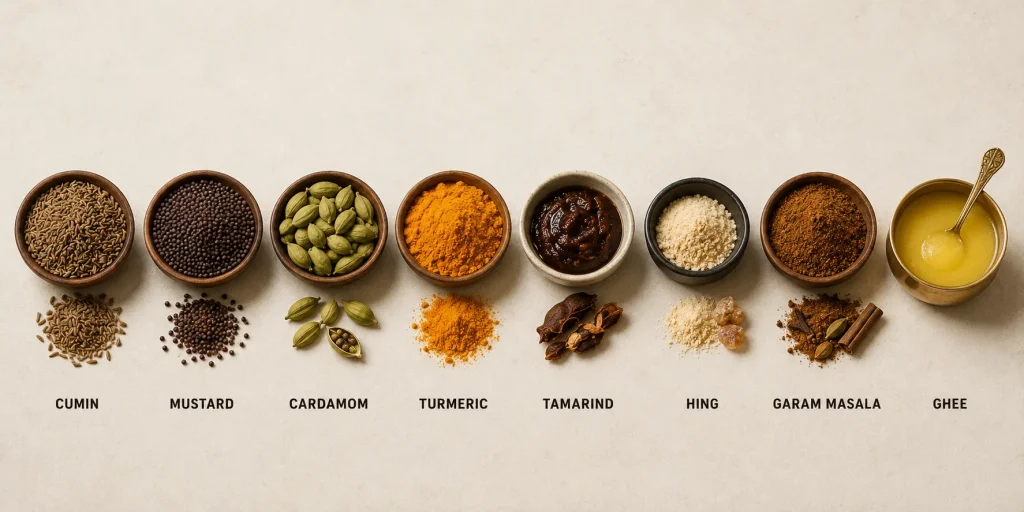
Indian Spice Comparison: Key Ingredients and What They’re Actually Doing
| Spice / Ingredient | Key Compounds | What It Contributes | Usually Added When | Raw vs Cooked |
|---|---|---|---|---|
| Cumin | Cuminaldehyde | Earthy, warm, slightly bitter base | Start of tadka in oil | Completely different — raw is sharp, cooked is rounded |
| Mustard seeds | Glucosinolates / isothiocyanates | Sharp, pungent, slightly nutty | First into hot oil — pop before adding others | Must be tempered — raw is unpleasantly bitter |
| Cardamom | 1,8-cineole, linalool | Floral, camphor-like sweetness | Added whole early, or ground into garam masala | Ground loses brightness fast; whole is more stable |
| Turmeric | Curcumin | Earthy bitterness, yellow colour | Early in wet cooking | Needs fat and heat to become bioavailable and flavourful |
| Tamarind | Tartaric acid | Deep, stable sourness | Late, or simmered into sauces | Heat-stable — holds up through long cooking |
| Asafoetida (hing) | Organosulfur compounds | Umami-adjacent savoriness | Tiny amount into hot oil before anything else | Inedible raw — transforms completely in heat |
| Garam masala | Mixed: eugenol, linalool, piperine | Warmth, complexity, aromatic top note | End of cooking, to preserve aroma | Added late specifically because volatile compounds dissipate |
| Ghee | Butyric acid, diacetyl | Nutty, caramelized fat carrier | Start of tadka or finishing | No raw application in Indian cooking — always cooked |
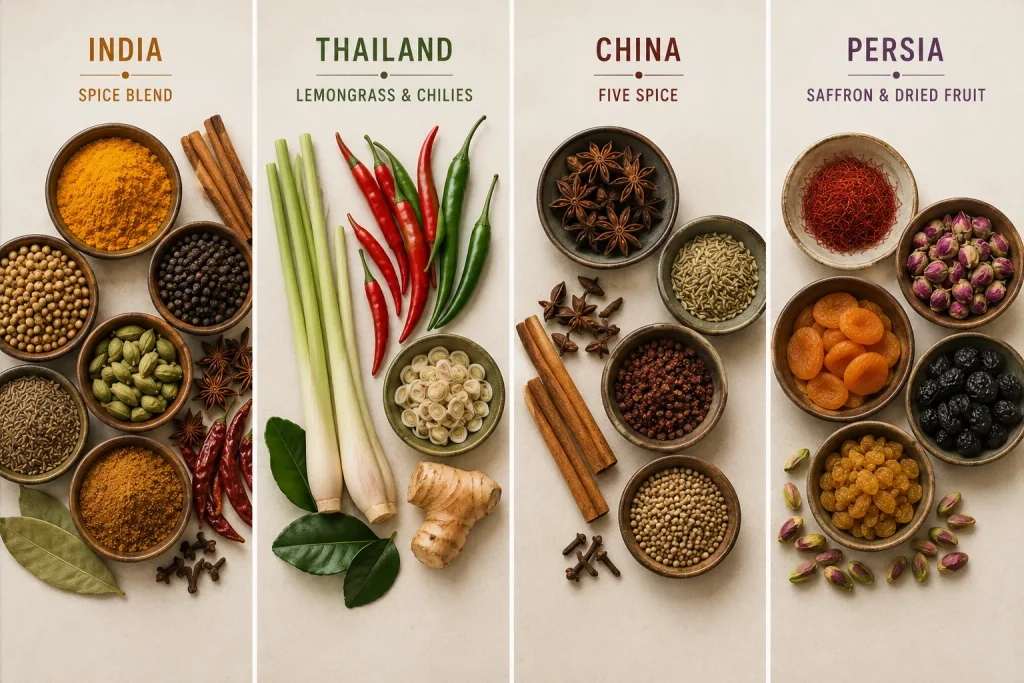
How Other Cuisines Handle the Same Flavor Challenge — And Why Indian Cooking Went a Different Direction
The drive to build complex flavor from plant-based ingredients is not unique to India. What is unique is the specific solution. Thai cuisine, for example, uses a similar arsenal of aromatics — lemongrass, galangal, kaffir lime leaf, chilies — but organizes them differently. As covered in detail on why Thai food balances flavors better than almost any other cuisine, Thai dishes aim for a sharp, bright balance of hot, sour, salty, and sweet that resolves cleanly. Indian cuisine layers those same dimensions but adds an earthiness from long-cooked bases that Thai cooking typically does not pursue.
Chinese five-spice is another version of the multi-spice blend principle — star anise, cloves, cinnamon, Sichuan pepper, fennel. But five-spice is a supporting player in Chinese cooking, used selectively. Indian cooking makes the spice blend the primary architecture of flavor. A cuisine that takes a similarly intentional approach to flavor building — though through entirely different means — is Mexican, where dried chilies, chocolate, and acidic elements are layered with comparable deliberateness. That contrast is worth exploring in why Mexican food is so flavorful.
Middle Eastern cooking, particularly Persian cuisine, uses many of the same spices as Indian food — cumin, coriander, turmeric, cinnamon — but tends toward positive pairing, combining them with ingredients like pomegranate, dried fruits, and nuts that share their warm, sweet aromatic character. The result is harmonious rather than tensioned. Interestingly, the historical overlap is real: the Mughal Empire brought Persian culinary tradition into northern India, and the two traditions absorbed each other. Biryani is essentially that meeting point — and its full story, tracing how a Persian rice dish became one of India’s most iconic preparations, is told in the history of biryani.
The key divergence is intent. Indian cooking is not accidentally complex — it is pursuing contrast, not resolution.
What This Means for How You Cook and Eat
The most practical thing this article can give you is this: the order spices are added matters enormously, and most home cooks outside India get it wrong. Adding all your spices at the same time into a dish produces a muddy, one-note result because you are not giving fat-soluble compounds the heat-and-fat extraction they need, and you are not building the layered timing that separates base notes from top notes.
Start with whole spices in hot oil or ghee, then aromatics (onion, garlic, ginger), then ground spices into the wet base, then finishing spices like garam masala or fresh herbs at the very end. Each addition is a separate extraction event at a different temperature and a different stage of moisture in the pan.
The other thing worth noting: dairy in Indian cooking (yogurt, cream, ghee) is not richness for its own sake. It is pH management and solvent technology. Yogurt or coconut milk helps to balance the spiciness of a dish — dairy products provide a cooling effect that counteracts the heat from capsaicin, creating a more harmonious blend. It also provides fat for further spice extraction and lactic acid that brightens the dish’s overall acidity.
Next time you eat Indian food, try to identify the moment when the dish resolves. With well-made Indian cooking, it does not fully resolve — there is always another layer arriving slightly behind the first one. That is the negative pairing principle at work. Your palate is chasing something that keeps moving. Most cuisines give you a destination. Indian food gives you a conversation.
The Regional Variations That Complicate the Story
The principles above describe broad tendencies — not universal rules, and definitely not a monolithic cuisine. India is enormous, ecologically diverse, and constituted of distinct culinary traditions that sometimes contradict each other dramatically.
South Indian cooking — particularly Tamil Nadu, Kerala, and Karnataka — is built around coconut, tamarind, curry leaves, and mustard seeds, with a strong preference for wet, fermented preparations like idli, dosa, and sambar. In South Indian cooking, the tadka is often added at the end of cooking, poured sizzling over dal or sambar. In North Indian cooking, it typically starts the dish. Same technique, opposite placement, different result.
North Indian cooking — the Mughal-influenced Punjabi and Awadhi traditions that most Western Indian restaurants are based on — leans heavily on dairy, onion-tomato bases, and warming spices like fenugreek and garam masala. It is richer, more sauce-forward, and more meat-centric than the South.
Kashmiri cooking is its own category entirely: heavy on whole spices like black cardamom and dried ginger, low on garlic and onion (for religious reasons in many households), and built around long-braised meats and dum cooking, where dishes are sealed and cooked in their own steam.
The negative pairing principle appears consistently across all of these traditions in the research data. The specific spices it applies to change dramatically by region.
The Bottom Line
Indian food tastes complex because it is using a fundamentally different flavor logic from most of the world’s cuisines. It has a strong signature of negative food pairing, where the more two ingredients share flavor compounds, the less likely they are to appear together in the same recipe. Every other layer — the tadka chemistry, the staged additions, the fat-soluble extractions, the capsaicin-endorphin loop — serves this central principle. The food is not throwing everything at the wall. It is systematically combining things that contrast rather than things that agree.
Once you understand that, eating Indian food changes. The thing you have been experiencing as “complexity” or “heat” or “depth” is actually a deliberate collision of unrelated sensory signals, each demanding attention at the same time, none canceling any other out. That is the goal. And now that you can taste the engineering behind it, a bowl of dal with a fresh tadka poured over it — something as simple as that — will never taste like a simple thing again.
People Also Ask
Why does Indian food taste so different from other cuisines?
Indian food is built on negative food pairing — its ingredients intentionally have very little in common in terms of flavor compounds, which is the direct opposite of how most Western and East Asian cuisines build flavor. Most cuisines combine ingredients that harmonize through shared compounds. Indian cooking combines things that contrast. That contrast is perceived as complexity, depth, and intensity — the sensation that no single flavor is fully resolving before another one arrives.
Why is Indian food so flavorful even with simple ingredients?
The flavor in Indian food is not primarily from expensive or rare ingredients. It is from extraction chemistry. Key flavor compounds in Indian spices are fat-soluble, not water-soluble, and cell walls break down under heat to release aromatic molecules that become more volatile. The tadka technique — blooming whole spices in hot fat — is designed specifically to pull out these compounds. A dish using only cumin, mustard seeds, and a few dried chilies can be extraordinarily complex if those spices are properly tempered, because the heat and fat are doing the extraction work.
What makes Indian spice combinations work so well together?
Counterintuitively, they work precisely because they do not match. Spices make the negative food pairing effect stronger — the presence of cayenne, garam masala, tamarind, ginger, and cinnamon each push Indian cuisine further away from flavor-sharing. Your brain cannot habituate to any single dominant flavor because there is no single dominant flavor. You are processing multiple distinct signals simultaneously, which is why Indian food holds your attention through an entire meal in a way that simpler flavor profiles cannot.
Why does Indian food taste better at restaurants than at home?
The most common home-cooking mistake is not giving the tadka step enough heat or time. Mustard seeds pop in 2 to 4 seconds at proper temperatures, cumin browns in 10 to 20 seconds and releases earthy oils — add cumin too early and it burns; add it too late and the oils never release properly. Restaurant cooks do this dozens of times a day and have calibrated the timing instinctively. The second issue is spice freshness — stale ground spices have lost most of their volatile compounds before they ever hit the pan. Fresh whole spices, ground at home and tempered properly, close most of the gap between home cooking and restaurant results.
Does Indian food actually have umami, or is that a Western thing?
Indian food has significant umami, though it rarely gets discussed that way. Asafoetida (hing) transforms from unpleasant-smelling when raw into a savory, umami-rich character when tempered in oil. Slow-cooked onions and garlic develop glutamates through the Maillard reaction. Fermented preparations like idli batter and dhokla develop umami through bacterial fermentation. Tomatoes, lentils, and long-cooked meats contribute additional glutamates. The umami in Indian food is built differently from Japanese cuisine — through browning, fermentation, and specific allium compounds rather than through kombu or katsuobushi — but it is absolutely present and doing the same flavor-amplifying work.
Is spicy Indian food actually painful, or is the heat different?
It is technically painful. Capsaicin activates the TRPV1 receptor, which is the same heat-sensing pain channel that fires when tissue temperature exceeds 43°C. The brain cannot distinguish capsaicin-triggered TRPV1 activation from actual heat damage, which is why spicy food causes sweating and the same physiological responses as real heat. What makes people enjoy it is that the body responds to this pain signal by releasing endorphins. Regular spice eaters are not experiencing less pain — they are experiencing the same pain with a stronger pleasure response and a higher tolerance threshold for triggering it.
Why do different Indian regions taste so completely different from each other?
The regional variation in Indian cooking reflects distinct geography, history, and ingredient availability rather than variations on a single theme. South Indian cooking is built around coconut, tamarind, and mustard seeds because those are the dominant crops of tropical coastal regions. North Indian cooking reflects Mughal influence in its use of dairy, long-cooked gravies, and warming whole spices. The negative food pairing pattern appears consistently across all regions in the research data — the principle stays constant while the specific ingredients applying it change dramatically.
Sources and References
The scientific foundation of this article rests on verified, published research. Specific claims about negative food pairing, tadka chemistry, and capsaicin biology come from the following sources:
- Jain A, Rakhi NK, Bagler G. (2015). Spices form the basis of food pairing in Indian cuisine. arXiv preprint arXiv:1502.03815. Indian Institute of Technology Jodhpur.
- Jain A et al. (2015). Analysis of food pairing in regional cuisines of India. PLOS ONE. (Full-text open access.)
- Data Mining Indian Recipes Reveals New Food Pairing Phenomenon. MIT Technology Review, February 2015. (Coverage of the IIT Jodhpur study.)
- The Science of Blooming Spices: Why It Matters for Flavour. Foodiesonly.in, January 2026.
- What’s the Science Behind Tadka?. Mendocino Food Consulting, December 2025. (Covers tadka chemistry including Maillard reaction and spice synergy.)
- Wikipedia: TRPV1. (Capsaicin receptor mechanism — well-sourced overview.)